











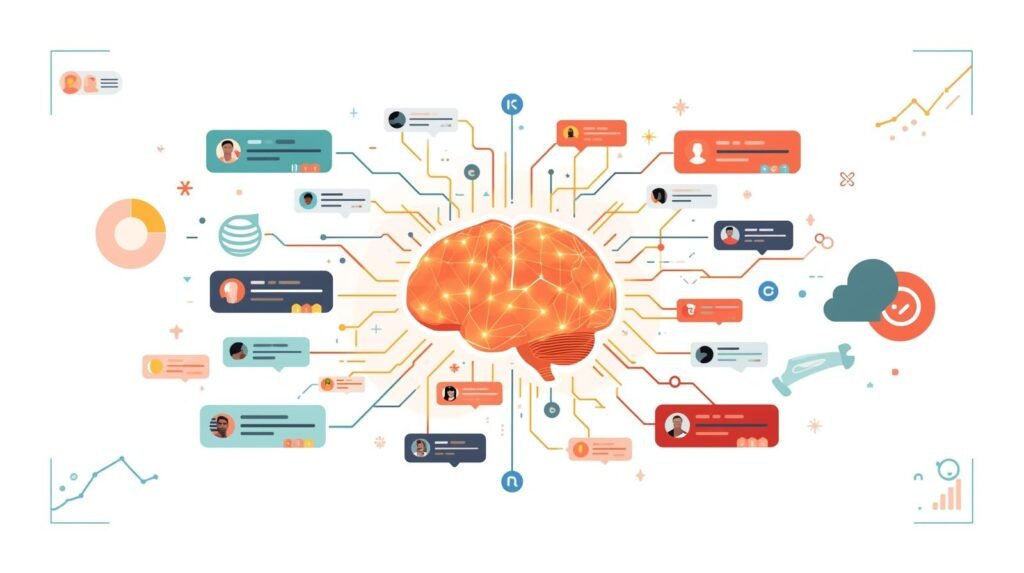
In addition to understanding AI-based technology as “digital magic,” you can now name and identify its individual parts. The invisible has been made visible. Your exploration of AI text analysis has taken the abstract idea of “AI” and broken it down into a set of tangible skills. The once mystical ability to understand emotion, the ability to know which part of a large amount of information is most relevant, and the process of breaking down large pieces of information into a list of identifiable concepts are no longer mysterious.
You have developed a new way to see these types of tools. For the next seven days, take note of their presence. Notice how a streaming service provides recommendations based on a reviewer’s sentiment analysis toward a particular film. Note how a news application identifies articles concerning different subject matter. Noticing where these tools exist will help further develop your new perspective by connecting your learning to your daily use of your own digital environment.
The above example is more than just a fun trivia exercise. It is a form of Digital Literacy. Understanding the core principles of NLP will provide you with the foundation to become a more informed and educated user within the digital community. By studying the fundamentals of NLP, you will now view the constant flow of text online as being processed, categorized, and used to produce your experience. You will no longer simply read about the content; you will also see the programming and code that produced the content.
Have you ever spent several hours reading hundreds of hotel reviews to find out which hotel actually had an excellent experience? In addition, some guests raved that the “hotel staff were fantastic,” whereas others claimed the hotel was “a total disaster” after staying there.
Reading reviews about hotels can be very time-consuming. If a computer could quickly analyze every comment made by every guest who visited your hotel, and then provide you with a general feeling for what those comments said, this would be similar to what we call Sentiment Analysis.
The purpose of Sentiment Analysis, or artificial intelligence, is to work quietly in the background through the Internet. For example, a business knows within minutes when one of its customers has an issue with the service it provides and posts about it on Twitter.
For another example, a website providing information on movies may summarize the opinions of thousands of people who viewed the movie. Sentiment Analysis is also referred to as “Opinion Mining.” The main goal of Opinion Mining is to read a piece of writing and determine the sentiment analysis behind it as being either positive, negative, or neutral.
#How Chatbots Accurately Understand Human Language
What Is Sentiment Analysis, Really? The Three-Pile Sorting Method
At its core, sentiment analysis is simply an incredibly fast method for grouping individuals’ feelings by emotions.
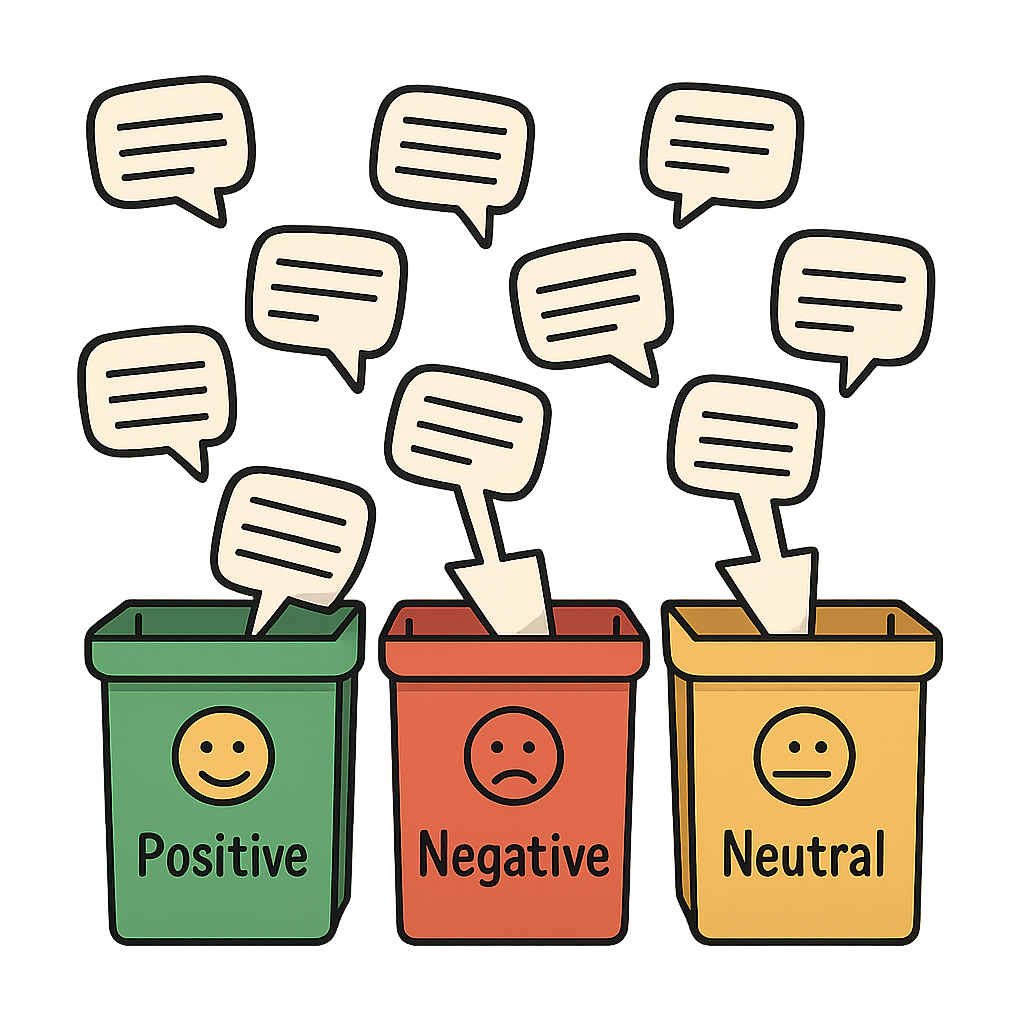
Imagine that you have a large pile of comments made by customers through their use of cards or notes — and your job is to sort those comments into three piles (good, bad, and fact) as quickly as possible — so if the computer were going to do the same thing, it would be using millions of tweets, product reviews, and emails at lightning speed. This is how businesses track customer sentiment analysis at scale.
A learning machine categorizes comments into one of three main forms of “polarity analysis” of “text.”
Positive: The comment is positive. The comment shows satisfaction or happiness. (example: “The camera on this phone is incredible!”)
Negative: The comment is negative. The comment expresses anger, frustration, and disappointment. (example: “I received my package broken.”)
Neutral: The comment is neutral. The comment states a fact or asks a question directly. There is no strong emotion expressed. (example: “Are headphones available in black or white?”)
It’s the separation of neutral comments that is key to performing real-time sentiment analysis. Sentiment analysis isn’t merely finding joy or anger. It also means knowing when a comment is stating a simple fact. This technology gives business owners a powerful snapshot of public opinion in real time. That snapshot provides business owners with an opportunity to improve everything from their products to their customer support.
Types of Sentiment Analysis
| Type | Description | Example |
|---|---|---|
| Polarity Detection | Positive/Negative/Neutral | Great service" - Positive |
| Emotion Detection | Identifies feelings | Happy, angry, sad |
| Aspect-Based | Focus on specific features | Battery is bad |
| Intent Analysis | Understand user intent | Complaint, feedback |
Source:
Why Do Companies Care? From Faster Support to Better Products
The 10,000 unhappy customers are just one indication of a problem with your business. The true potential comes from understanding the specific problems these unhappy customers have with your product or service and knowing which customers need help first. Your company can also turn an endless list of customer complaints into action-oriented improvement plans using the emotional aspects of those comments.
Your company will make two very important changes concerning how you interact with you as a customer. Those changes are designed to fix some of the same types of problems you’ve dealt with before.
Get Help Right Away When Things Go Wrong
This program is similar to an Emergency Room in terms of Customer Service problems. Anytime your customer uses words in their comment that indicate there is a problem with the product/service; i.e. “My Flight Was Cancelled”, “Your Site Isn’t Working” instead of just stating that they have a neutral concern about the service/product; (i.e. “I Wish I Had More Snack Options”), the words in those comments will be bolded/underline/highlighted etc.
The Representative will be able to see them right away and begin assisting your customer immediately.
Build What Customers Want
A large, self-organized ‘suggestion box’ is another use for this type of technology. For example, when an app developer discovers many users are commenting positively (complimenting) their new app with respect to “the new photo filter,” yet they are also expressing concern about how the app is consuming their phone’s power (“draining my battery”) or how poorly it was developed (“the app”), the app developer has a much clearer picture of which aspects to develop further and which were developed well.
Brand Monitoring is not just identifying what consumers like from a product/service vs. what they dislike. Rather, it leverages unparalleled access to consumer opinions and experiences by utilizing an ever-growing, real-time feed of user commentary on social media and online reviews. Brand Monitoring enables continuous monitoring of a company’s brand(s), helping keep the brand “online
#Understanding the Basics of Neural Networks: A Practical Guide
Business Impact Statistics
| Metric | Data |
|---|---|
| Companiess using AI for customer insights | 60%+ |
| Customer experience improvement | Significant |
| Revenue increase from personalization | Up to 15% |
| chatbot usage for support | 70% interactions |
| Data-deriven companies profitability | Higher than competitors |
Source:
How Companies “Listen” to the Internet: The World of Brand Monitoring
Beginning of the Text. Real-time is what Brand Monitoring is really about. Real-time listening is the major component of Brand Monitoring. Therefore, Brand Monitoring Systems do not wait until consumers contact you with a complaint; rather, they continually scan the Internet for references to your Company Name, Product Names, and People representing your Brand (e.g., CEOs).
A significant part of this is Social Media Listening. For example, when a new sneaker comes out, your monitoring tools will listen to comments on your Instagram account and track millions of public posts across social media sites such as Facebook, LinkedIn, Twitter, and TikTok for mentions of your sneaker name.
This allows you to build a Live Dashboard showing how your customers feel – whether it’s a positive emotion (e.g., excitement) or a negative emotion (e.g., disappointment). With the help of Text Analysis, you can quickly identify the emotions your customers express and categorize them into three categories: Positive, Negative & Neutral.
Because of this instantaneous feedback loop, companies can respond rapidly. If a YouTube reviewer recently wrote a very positive review of your company, your system can immediately pick up a positive signal from that influencer and act on it.
Conversely, if a recent software release caused users’ phones to crash and they start posting about their anger toward the app, the computer will instantly recognize a large spike in negative posts and notify the engineers of a problem before it reaches national news.
Real-World Example: Brand Monitoring
| Example | Socail Media Monitoring |
|---|---|
| Company tracks mentions on TWitter /X | |
| AI detects negative sentiment spikes | |
| Immediate response to customer complaints | |
| Result: | Faster issue resolution |
| Improved brand reputation |
Source:
So, How Does a Computer Learn to Feel? A Tale of Two Methods
In other words, how does a computer know whether a tweet on your product or service was generated because someone liked it, rather than disliked it? One way was essentially a high-tech version of Word Scramble. An algorithm — a computer’s instruction book — was developed utilizing two dictionaries: one positive with terms like “love”, “excellent”, and “perfect”.
Additionally, there were two negative dictionaries that included terms such as “terrible,” “broken,” and “slow”. The computer used a point system to scan each sentence. It would add points when it recognized positive words and subtract points when it recognized negative words. Then, based on which had the highest score, it would declare what was the best.
You can quickly see why using such a straightforward approach could lead to inaccuracies. For example, if a customer tweeted “this was not the experience I wanted”, a simple point system might identify the word “wanted” and categorize the statement as a positive statement. In short, I’ve seen the words but completely overlooked the actual meaning. Thus, relying upon such simplistic methods to gauge customer sentiment analysis may provide you with misleading information about sentiment analysis.
The approach to addressing the issue underwent dramatic changes once an innovative method emerged: teaching computers through examples. Instead of supplying a list of words, programmers supplied systems with millions of reviews written by humans who identified them in advance. A review would look something like “I love this product!” and would be labeled “positive”. Another review would be displayed, identified as “Fell apart within a day,” and labeled “negative”.
Then the computer analyzed all of the above examples and would establish its own understanding of language patterns. The description above is a simplified explanation of some concepts found in AI. There are additional advantages to this method. The computer now understands context of what has been communicated to it; for example, it identifies that “not amazing” is the opposite of “amazing”. While this method is far superior to previous methods, human communication can often confuse the computer, and sarcasm is perhaps the most confounding.
Rule-Based vs Machine Learning Methods
| Method | Approach | Strength | Limitation |
|---|---|---|---|
| Rule-Based | Keyword & lexicon | Simple & fast | Limited accuracy |
| Machine Learning | Trained models | Better accuracy | Needs data |
| Deep Learning | Neural networks | Context-aware | Resource-heavy |
Source:
“Great, My Package is Lost. Just Perfect.” Why Sarcasm Is So Tricky
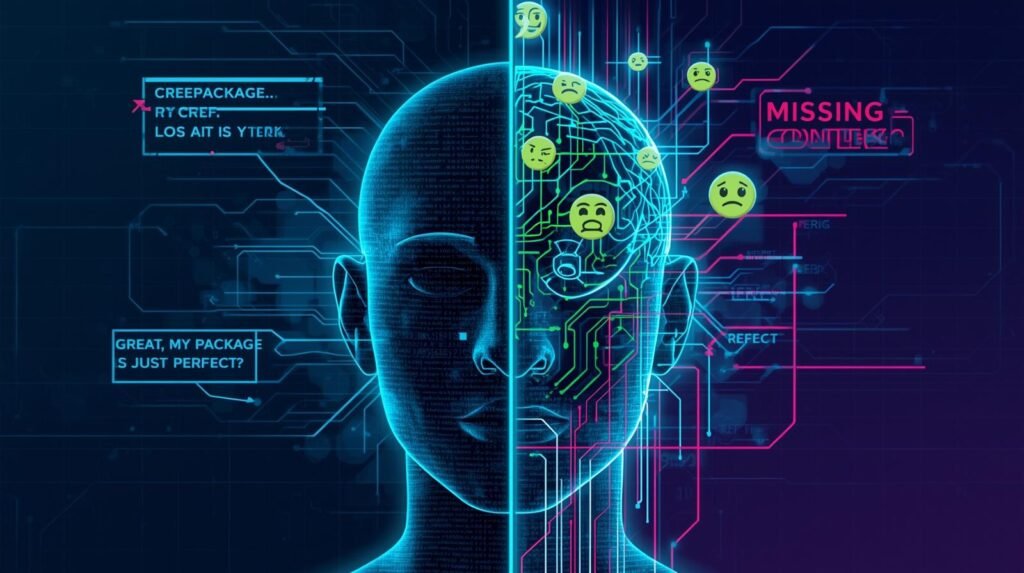
The words “Great, my package is lost. Just perfect,” convey a specific feeling to humans immediately. However, it is probable that they would cause confusion for computers. While the positive words in the statement (“Great”, “Perfect”) may suggest to a computer a positive sentiment analysis or a sense of happiness, the computer would miss the anger conveyed by the overall comment.
In addition, because the literal language used does not represent the actual intention of the message, as is typical of all types of sarcasm, it presents another problem for computers attempting to determine how positive or negative someone’s feelings are toward their experiences based on comments.
Finally, the last part of solving the mystery of A.I. is context. Context is simply referring to the extra (or surrounding) information that contributes to your interpretation of what was said.
Most humans have no difficulty recognizing that “Great” has been used to express sarcasm when taken in the light of the rest of the sentence, “My package is lost.” Unfortunately, humans do not interpret things the same way computers do. Therefore, linking those concepts together is much easier for most people than for computers. There is considerable complexity involved in developing an application to determine the polarity of user-generated text. That complexity is primarily due to the number of unwritten rules that govern effective communication through language.
Sarcasm detection is currently one of the largest areas of research among developers seeking to build A.I. applications that utilize emotion. Advances in A.I. are occurring rapidly; however, there are still several opportunities for development. Even though a comment may appear clearly negative, there is a potential opportunity to extract value. For instance, knowing a customer is dissatisfied versus knowing why he/she is dissatisfied.
Sentiment Challenges
| Challenge | Example | Why It's Hard |
|---|---|---|
| Sarcasm | Great, just what I needed | Opposite meaning |
| Context | It's cold | Depends on situation |
| Slang | This is lit | Informal language |
| Mixed sentiment | Good but expensive | Conflicting signals |
Source:
Beyond ‘Good’ or ‘Bad’: Finding Out What People Like
Understanding whether a reviewer has commented negatively about your company is a great way to begin to understand what customers are saying. However, it is only a first step. In addition to being able to tell if a review is negative, you will likely also want to know why they said it was negative.
For example, if a consumer leaves an online review stating, “The pizza was fantastic; however, the service was incredibly slow,” and you rate this review as negative, you have absolutely no idea if their problem had anything to do with the quality of the pizza, the price of the pizza, the staff, etc. If your organization wants to leverage customer feedback and understand where changes are needed, you need to look beyond the thumbs-up/thumbs-down nature of reviews.
At this point in our discussion, we find ourselves moving from basic sentiment analysis to more advanced levels of sentiment analysis. Sentiment Analysis Technology can be used to identify the topics (features/aspects) reviewers discuss, rather than merely issuing a thumbs-up or thumbs-down on each review. Additionally, the technology can provide a sentiment analysis assessment for each feature or topic.
This method of analysis is referred to as Aspect-based Opinion Mining and is analogous to giving a product a report card on how well it scores on each criterion, rather than a simple letter grade.
In terms of specific value-added details for a business, this will represent high value. This represents the ability of the business to understand exactly what works and what does not work. For example, if we were reviewing a large number of reviews for a complex product (i.e. a new smartphone), using the analysis methodology above, the manufacturer could provide a summary of all reviews at once and state something like:
Camera: Good (“The photos are amazing”)
Battery Life: Bad (“Barely lasts a full day”)
Screen: Good (“The display is bright and clear”)
Price: Middle Ground (“It is priced similarly to other smartphones”)
In this manner, the company now has a clear direction: launch a strong promotional campaign to market the phone’s camera’s superior photo capabilities and clearly define where improvements are needed in battery life. When companies can fully comprehend customer needs and preferences through timely, relevant feedback from analyses of those areas, their ability to receive that feedback is significantly improved. However, simply knowing whether something is good/bad is only half of the emotional picture.
#A Comprehensive Guide to AI Model Types
From ‘Happy’ to ‘Excited’: The Next Frontier of Emotion Artificial Intelligence
A positive review indicates that something happened to the reviewer that caused them to feel a certain way toward their experience. It provides insight into a consumer’s thoughts about a purchased item. But it does not tell us much else about how the reviewer feels. For instance, one reviewer might have been completely satisfied with the item he purchased, while another might have been ecstatic.
In addition to classifying whether a review is positive or negative, emotion Artificial Intelligence (Emotion AI) can classify the different emotions expressed by the reviewer when writing their review — including happiness, anger, sadness, and surprise. Classifying positive/negative reviews and classifying emotion reviews represents the same kind of difference that exists in photographs.
From just black-and-white photography, we now have color photography.
The potential of Emotion AI to detect subtle emotions, especially in customer support services, is significant. Let’s look at an example of a customer who writes to complain about a defective product. If the system detects that the reviewer is dissatisfied with their product in general terms.
The automated reply could direct the customer to a web page with a link to help with their problem. However, if the system detects extreme levels of anger or frustration, it could flag the message for immediate human attention. Businesses will now be able to adjust their responses based on their customers’ true emotional state, thereby achieving faster resolution of their problems.
Combining the “what” (battery performance) with the “how” (frustration, etc.), this advanced natural language processing-based emotion detection tool allows companies to gain a more comprehensive and detailed understanding of how consumers perceive products and services. Not only will it allow the company to know what needs to be fixed, but it will also give it insight into which things most affect its customers emotionally.
This idea is already coming together due to technological advancements; however, many high-level tools are available today that enable businesses to create this level of detailed emotional awareness.
To a business, this data will be extremely valuable. The amount of detail will enable the company to understand exactly what works and what does not work. For instance, if we were evaluating a complex product (new smart phone) and had thousands of reviews, we would be able to evaluate each one of those reviews at once.
The Toolbox: What Software Makes This All Possible?
You can imagine a group of engineers designing a system like this. But in reality, most companies use pre-built Voice of Customer (VOC) platforms to build their own emotional analysis systems. Therefore, regardless of whether a company is large and technologically advanced, it does not need a technological advantage to know what people are saying about it online. They just need a suitable VOC platform or tool.
A company’s reputation can be viewed as a central source where customers can provide feedback on their experiences with products and services. Instead of requiring a manual search through over 100,000 customer reviews, a VOC application pulls all relevant information from sources such as social media, customer service emails, and review sites. It also performs automated sentiment analysis on information collected by the VOC application and displays the results in a graphical format, enabling the company manager to immediately recognize trends and patterns in customer feedback.
As a result of its availability, it has become cost-effective for businesses of all sizes to use powerful text analysis for real-time brand monitoring and to listen to how customers feel about their brands. Numerous organizations have purchased VOC applications. In fact, VOC applications are so common that many companies use them behind the scenes as a decision-making resource to influence and shape consumer purchasing decisions, alongside the advertisements consumers see.
How This “Invisible” Tech Shapes Your World
Customer opinions — whether through a comment on social media or a star rating in a review — are analyzed through sentiment analysis to help understand what they think. Now when you look back at the same description for something, or the number of stars that were assigned to it — you will see that there is so much more to that single digit than you may have thought to know – there are thousands/hundreds of pieces of data collected from many other people who have put their opinions together, all because of the process called sentiment analysis.
You should also realize just how valuable your contributions (whether it’s a negative tweet or a positive review) are to everyone else. Sentiment analysis allows companies to use customer feedback on social media and improve customer experience. Therefore, companies can provide immediate responses to customer feedback via social media. So while your voice was able to communicate with a company sooner rather than later, today your voice to a company will receive a response faster than ever.
FThis new awareness of digital literacy could begin as simply as this: Recognize. Every time you read reviews on an app, or every time you watch a company responding immediately on-line — stop for a moment. That text classification is occurring right in front of you. In doing so, you will become more knowledgeable about Digital Literacy. Understanding the basics of sentiment analysis provides one of the greatest elements of our society today.
No longer are you merely a passive user; you are now a conscious Digital Citizen — having a greater perspective on how your thoughts influence the Internet you utilize every day.
Q & A
- What is sentiment analysis (in simple terms)?
Sentiment analysis is a method that analyzes text (such as reviews, tweets, or support messages) and labels its sentiment—usually positive, negative, or neutral. It doesn’t “feel” emotions the way people do. Instead, it looks for patterns in words and phrases that often match certain opinions. The main benefit is speed: it can scan thousands of messages and summarize the overall mood in minutes. - How does Artificial Intelligence figure out if a message is positive, negative, or neutral?
Most modern systems use Natural Language Processing (NLP) to prepare text (split it into parts, clean it, and turn words into numbers). Then, a trained model predicts the likely sentiment analysis based on examples it has previously learned. If it has seen many phrases like “works great” labeled positive and “stopped working” labeled negative, it learns those patterns. Some systems return a label, while others return a score (e.g., -1 to +1) along with a confidence level. - What’s the difference between rule-based and machine-learning approaches?
A rule-based approach uses predefined word lists and rules (for example, “love” = positive, “terrible” = negative). It’s easy to understand but often fails with context, negations (“not good”), and sarcasm.
A machine-learning approach learns from labeled examples and can handle greater natural-language variation. It’s usually more accurate in real-world writing, but it depends heavily on the quality of the training data and can still make mistakes when language gets tricky. - Why is sarcasm so hard for sentiment analysis?
Sarcasm often uses positive words to express a negative feeling (example: “Great, my package is lost.”). A system may see “Great” and guess “positive” unless it understands the full context. Humans use shared knowledge and tone cues that aren’t always present in plain text. Even advanced models can struggle when the “true meaning” contradicts the literal words. - Can sentiment analysis detect specific emotions, such as anger or joy?
Sometimes. Basic systems focus on polarity (positive/negative/neutral). More advanced emotion detection systems aim to label emotions such as joy, anger, sadness, or fear. This is more difficult because emotions overlap, people express them differently, and context matters substantially. Emotion labels also depend on the training dataset—if the training examples are limited, the emotion predictions can be unreliable. - What are the most common real-world uses—and what are the limits? Common uses include tracking customer feedback, monitoring social media reactions, triaging support tickets, and summarizing opinions about products or events through text analysis. The limits are important: models can be biased by their training data, misunderstand slang or sarcasm, and oversimplify mixed opinions (like “great camera, awful battery”). The safest approach is to treat results as signals, not facts—especially for sensitive decisions—and to combine automated results with human review when the stakes are high (e.g., sentiment analysis).