













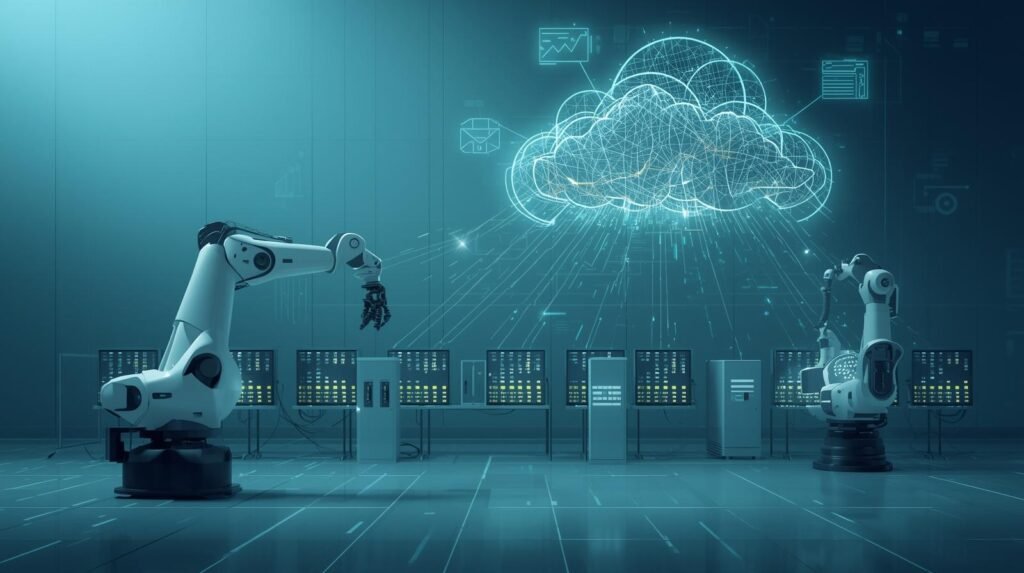
A self-driving automobile was traveling along the highway. It had to stop suddenly as an object appeared on the roadway, first as a ball, followed closely by a very young child. To avoid hitting either the ball or the child, the vehicle stopped almost instantly due to rapid deceleration. Since the vehicle would have taken too long to send a video of the incident back to a distant server over several hundred miles, and then wait for instructions from the server, how could the vehicle react so fast?
The requirement for instantaneous action by a smart robot is fundamentally rooted in the problem of transferring data across the Internet at a rate which allows for timely feedback (robotic latency) from a remotely located source — and for a delivery drone attempting to avoid collision with a bird, or a robotic surgical tool attempting to complete a precise cut — could be the difference between a successful outcome or catastrophe.
To facilitate real-time decision-making by a smart robot, a distributed model of robotic intelligence is employed. Rather than having the robot’s “intelligence center” be a single point of origin, intelligence is distributed among multiple points. A relatively small component of the robot’s overall intelligence — one designed for rapid decision-making and rapid reflexes — is located in or near the robot (or device), while a much larger component of the robot’s intelligence — one designed for longer-term, higher-level thought and learning processes — exists in “the cloud.”
This strong partnership forms the basis on which Hybrid Cloud Robotics operates and will provide the foundation for developing autonomous vehicles, high-efficiency automated warehouses, and many other advanced intelligent systems.
Hybrid Cloud Edge Robotics: Cloud Intelligence Meets Real-Time Robotic Action
Hybrid Cloud and Edge Computing will significantly impact how robots sense their surroundings, move, and learn about their environment. With Hybrid Cloud Edge Robotics, you can enable Cloud-scale intelligence in your robots, allowing them to act in real time. That means your robots can have the “reflex” of being controlled by a decision made at the edge of the network and still have access to the “growth of the brain,” which involves large-scale models, large amounts of data, and the ability for all of your robots to learn together.
In essence, Hybrid Cloud Edge Robotics combines the “edge” capabilities of a robot’s reflexes and the “cloud” capabilities of a robot’s brain growth. As robots continue to transition out of labs and into warehouses, hospitals, streets, and factories — environments where milliseconds can mean the difference between success and failure — this capability will become increasingly critical.
The edge side of Hybrid Cloud Edge Robotics addresses those time-sensitive applications such as Sensor Fusion, Obstacle Avoidance, Motion Control Loops, Safety Stops, and Local Perception Updates. The Cloud side of Hybrid Cloud Edge Robotics supports applications that leverage scale, such as Model Training, Simulation, Long-Horizon Planning, Analytics, and Policy Improvements Across the Fleet.
Hybrid Cloud Edge Robotics also enables cost savings by allowing you to use elastic cloud-based infrastructure for expensive burst training sessions and then deploy smaller edge-based devices to handle day-to-day inference and control. Additionally, if the architecture is properly designed, it can remain functional when communication is interrupted.
A typical Architecture for Hybrid Cloud Edge Robotics consists of Three Layers (Robot, Edge Node, and Cloud), each with distinct functionalities. The Robot layer includes cameras, lidars, encoders, and a control processor that enables the robot to immediately respond to movement requests. The Edge Node is typically housed within a server room or is co-located with a 5G/MEC Site.
The Edge Node aggregates data from multiple robots, caches models, and offers low-latency services, including mapping, coordination, and video analytics. Conversely, the Cloud layer is responsible for providing central identity and device management, data lakes, and pipelines.
Hybrid Cloud Edge Robotics becomes even stronger when each layer can utilize consistent APIs, logging, and model versioning.
In addition to the processing power, Hybrid Cloud Edge Robotics really comes down to how the data flows. Due to the volume of sensor data collected, transmitting all of it to the cloud is resource-intensive and costly. Therefore, hybrid-cloud edge robotics reduces the amount of data transmitted back to the cloud by filtering out irrelevant data, such as event detection, embedding, anomaly detection, and short clips of the incident surrounding an event.
In turn, this allows users of Hybrid Cloud Edge Robotics to retain sensitive data at the edge while generating new, useful training datasets using methods such as de-identification, aggregation, or federated learning. Ultimately, the cloud will enable better perception and decision-making algorithms, and the edge will enable safer deployment of those algorithms through rolling updates, canary deployments, and instant rollbacks.
Reliability is critical to real-time actions. Hybrid Cloud Edge Robotics offers graceful degradation, maintaining robot operation even when network performance is less than ideal. If a robust network is established, the robots can offload computationally intensive processes to remote servers, retrieve up-to-date routing information, and remain continuously synchronized with their map data. As network performance diminishes, the robots will continue to function autonomously without creating unsafe conditions.
To accomplish this, Hybrid Cloud Edge Robotics utilizes techniques such as local caching (using the most recent version/model/policy) heartbeats to monitor communication and “safe mode” functionality that limits speeds or causes the robot to revert to a safe operating condition. The end result is maintaining productivity while enabling improvements in the robot’s capabilities once network connectivity is restored.
Hybrid Cloud Edge Robotics is currently being deployed across a range of applications. In warehouses, large numbers of mobile robots are used to manage traffic flow and select routes that best utilize local decision-making, while the cloud determines the optimal overall configuration for all robots in the warehouse and optimizes warehouse throughput daily based on what each shift learns.
On manufacturing floors, Hybrid Cloud Edge Robotics provides edge-based robotic arm precision control, cloud-based analysis of quality trend data, and updates to machine vision models across multiple manufacturing facilities. In healthcare settings, service robots must navigate immediately while preserving the strict privacy of patient-adjacent sensor data. Hybrid Cloud Edge Robotics meets these requirements by retaining patient adjacent sensor data locally and delivering cloud-based analytics for predictive maintenance and planning.
As noted in the previous section, the cybersecurity and management components of Hybrid Cloud Edge Robotics should be developed concurrently with the technology’s design and development. Due to the nature of Hybrid Cloud Edge Robotics as a Cyber Physical System (CPS), any compromise or issue in the CPS can result in damage to humans or property. Therefore, Hybrid Cloud Edge Robotics must implement a number of security measures as minimums for device identity authentication, encryption of all communications, signed model artifact validation, and role-based access control.
In addition, Hybrid Cloud Edge Robotics must maintain an audit trail detailing who deployed a particular model, when its parameters were last changed, and what prompted a robot to make a particular decision. There are other policy decisions that need to be made regarding Hybrid Cloud Edge Robotics, such as what types of data may leave a site, how long data will be stored before being deleted, and how updates to a specific model will be approved, especially when working within regulatory environments.
The operational and monitoring elements of Hybrid Cloud Edge Robotics represent the next step for any team transitioning their work from prototype to production. A successful transition to production means having real-time visibility into latency, battery health, motor temperatures, sensor drift, and model performance.
Hybrid Cloud Edge Robotics provides several tools to support this process, including fleet dashboards, over-the-air updates, remote debugging, and automatic incident capture and failure analysis. Properly enabling observability of your environment allows you to detect gradual degradation in cameras, detect lighting changes that affect a robot’s ability to perceive its surroundings, and apply targeted patches to models quickly without shutting down the entire fleet.
Going forward, Hybrid Cloud Edge Robotics will combine traditional control techniques with edge-AI and cloud-scale training. Larger foundation models will enable more general models across multiple domains, but due to the extreme limitations of edge computing environments, efficient inference, quantization, and specialized accelerators will still be necessary.
Additional value will be delivered through synthetic data pipelines, improved simulators, and digital twins, enabling systems to train safely in simulation environments before deployment in the physical world. Ultimately, the fundamental promise of Hybrid Cloud Edge Robotics remains the same: cloud-based intelligence enables continuous improvement while edge-based execution enables timely and trusted actions.
From Reflex to Reason: How Modern Robotics Thinks
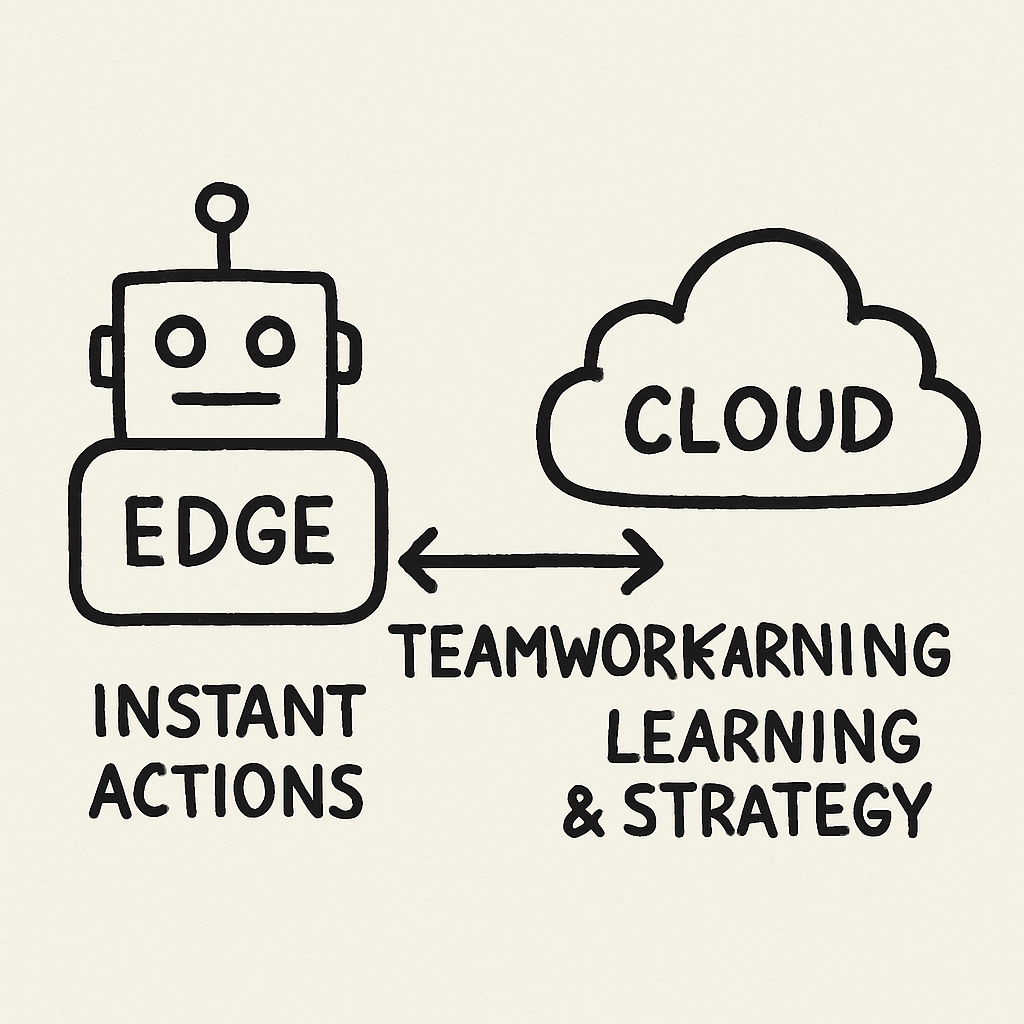
In other words, the fast thinking that enabled a self-driving vehicle to respond seemed like magic. But you now understand that it was a partnership. Just as we are made up of two types of actions: fast, automatic actions to prevent harm to ourselves (our Nervous System) and slow, deliberate actions to anticipate and prepare for events we might experience in the future (our Cognition); similarly, smart machines must also have the capacity to act quickly to present danger and strategically to future challenges. Consequently, you can now express with certainty that Hybrid Cloud Robotics relies upon the teamwork required in Collaborative Work.
The next step in your education is not to create a Robot, but to start seeing Robots in this context. Next time you see a Drone delivering packages, a Smart Vacuum Cleaner cleaning your floors, or reading an article about an Automated Checkout, try to envision the “invisible dance” happening behind the scenes. Ask yourself: What percent of the activity is a quick reaction versus what percent of the activity involves thoughtfulness? It is one method to make Edge Computing in Action a part of your personal knowledge base.
With this understanding, you now have the ability to view a rapidly evolving technological world and focus beyond the Machine itself to comprehend the invisible Systems that guide its Intelligence. Simply put, you don’t just observe Technology; you know how it works.
The Problem of Delay: Why Robots Can’t Just Use the Internet for Everything
One of the main reasons for using an alternative to cloud-based brains is due to the physical location of both the robot and the brain. Even at the speed of light, sending commands to a computer server in Europe or Asia results in some delay (latency) before receiving a reply. This can be critical when a self-driving car detects a bike swerving into its lane, since only a few milliseconds may separate a successful avoidance maneuver from a collision with the bike.
Latency refers to how quickly a device responds to commands from a remote server. I’m sure we have all experienced this lag during video calls when our friend freezes mid-sentence. Video calls are frustrating when they become stuck, but a robotic device experiencing latency issues will be completely useless. For example, a delivery drone attempting to navigate around pedestrians on a crowded street may experience such severe latency that, instead of dodging the pedestrians, it crashes into them.
There is no way that simply relying on cloud-based intelligent systems will work. Clouds are great for large-scale machine learning and big data analytics; however, they introduce significant latency that cannot be overcome in real-world applications. A new model has been proposed in which a robot includes a fast, responsive nervous system (reflexes).
Why Speed Matters: Cloud vs Edge Reaction Time
[table “283” not found /]Source:
The Solution for Speed: Giving Robots ‘Reflexes’ with Edge Computing

To solve the delay issue, engineers developed an alternative. The engineer realized the robot could not simply sit and wait for authorization from a remote server. Instead, by using edge computing, the robot could think for itself quickly.
In a similar manner to how your body works through its reflexes (i.e., when you place your hand near the top of a hot stove, your hand pulls back rapidly even before you realize you’re feeling pain), edge computing allows a mini-brain to exist in a small, yet powerful form factor at the “edge” of a network enabling instant decision-making.
You may be aware of this type of technology. A smart vacuum cleaner doesn’t send video footage to the Internet and then check whether it should avoid going over a chair leg as it navigates; instead, it relies on sensors, which allow it to turn around nearly instantly. By acting on local information, the robot’s operation speeds up dramatically. A clunky robot becomes a quick, agile assistant capable of traversing complex spaces with minimal assistance.
Although the mini-brain within the robot operates effectively for rapid responses, it still has limits. While the mini-brain is ideal for speed, it cannot store large amounts of data for extended periods or perform heavy computational tasks. For such operations, our robot still needs access to the “brain in the cloud.
Robotics Edge Computing: Low-Latency Computing for Intelligent Robots
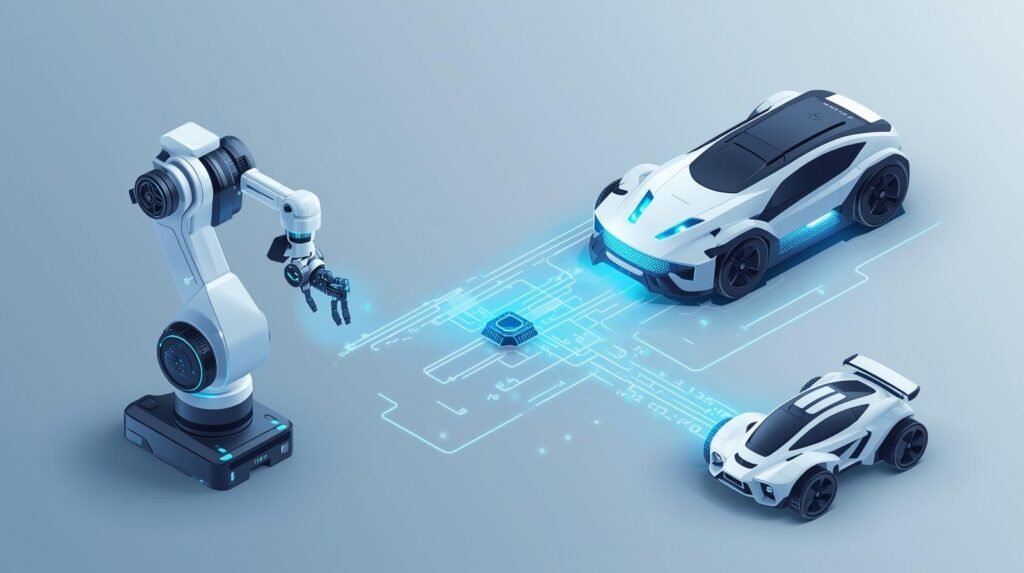
Robotics Edge Computing means deploying robot workloads with the highest priority near the robot — either onboard the robot, on an on-site server, or on a nearby edge server. The main reason for deploying robotic Edge Computing is to reduce delays in robot sensing inputs and increase reliability for remotely operated robots. As a result, it is possible to continue operating with a responsive robot that responds to individuals, objects, and other environmental stimuli within milliseconds, enabling improved navigation capabilities and greater precision in object manipulation.
An important advantage of using Robotics Edge Computing is the opportunity to provide real-time perception and control. Sensor data arriving continuously from cameras, Lidars, force sensors, and encoders must be processed as it arrives. Robotics Edge Computing enables rapid sensor fusion, object detection, localization, path planning, and control loop execution without sending data back and forth to remote data centers.
Lower latency associated with this localized processing pipeline will lead to safer operation (i.e., quicker stop/avoidance response) and better operation (smoother motion, fewer errors, higher throughput) for the robot, while reducing total cost of ownership and increasing operational efficiency.
Robotic Edge Computing may also assist in reducing network bandwidth utilization and operational costs through the transmission of only event-detection, anomaly detection, summaries, etc. versus the need to transmit full-motion video or full-point clouds over the Internet to remote data centers. This provides increased scalability in fleets and meets all necessary privacy and regulatory compliance, since all sensitive information remains on-site
Robots using Robotics Edge Computing may also perform “Offline-First” mission-critical tasks when they are not connected to the cloud, then sync their logs and metrics when they reconnect to the cloud. Most robotics projects use edge computing in conjunction with Hybrid Cloud Edge Robotics. The hybrid edge-cloud architecture enables time-sensitive processing at the edge and non-real-time processing in the cloud (such as big data simulations, analytics, etc.).
Teams utilizing Hybrid Cloud Edge Robotics can continuously push and deploy new models across multiple robots in real time while maintaining control over how the robots operate. Additionally, Hybrid Cloud Edge Robotics provides centralized governance capabilities (Signed Artifact Management, Identity & Access Control, Audit Trail Management) while granting each individual robot at the edge complete autonomy.
Teams utilizing both Hybrid Cloud Edge Robotics and Robotics Edge Computing are able to strike a balance between rapidly making decisions locally and leveraging scalable intelligence in the cloud. As a result, these robots can make rapid decisions based on locally available information in real time; they can continually learn, adapt, and remain remotely manageable as the number of robots grows.
Edge Computing Robotics: Real-Time Intelligence Where Robots Operate
Edge computing for robotics enables real-time processing of robotic systems — either on board a robot, in proximity to a gateway, or on an on-site edge computer — providing rapid decisions and responses from the robot. This means Edge Computing Robotics does not require a robotic system to travel to a remote data center to obtain perception, planning, and safety behavior before taking action.
For instance, recognizing when a person may be entering its path and adjusting the pressure applied to a fragile product could be an application in which Edge Computing Robotics would provide significant value. Similarly, navigating a small passageway rapidly could also benefit from Edge Computing Robotics.
In addition to the examples above, Edge Computing Robotics will support many time-sensitive and data-intensive workloads, including sensor fusion, object detection, SLAM/localization, collision avoidance, and control-loop execution. These workloads are sensitive to latency (jitter), and Edge Computing Robotics can execute them locally without a network connection. As a result, this technology supports consistent and reliable operation by enabling autonomous operation even during periods of reduced or no connectivity.
The use of Hybrid Cloud Edge Robotics aims to leverage the strengths of each method: speed and efficiency at the edge, and scalability and intelligence in the cloud. By using hybrid methods, Hybrid Cloud Edge Robotics enables model and analytics training and simulation across fleets, as well as centralized management. However, it also enables real-time decision-making at the edge, allowing for faster response times. Hybrid Cloud Edge Robotics also supports staged rollouts. For example, a company could update a few robots at a time, see how they function before updating additional robots.
A further benefit of this type of architecture is that it will provide companies with a single source for logging, policy enforcement, and security management across multiple locations. When used in conjunction with Edge Computing Robotics, Hybrid Cloud Edge Robotics will create a real-time, intelligent system that continually learns and adapts — allowing robots to be consistently responsive and improving their functionality at the point of operation.
Edge computing in robotics has one major advantage when implemented at scale with many robots: it enables a coordinated response. Each local edge device can communicate traffic information and share maps to coordinate actions of other devices located in the same building. In addition, a unified logging and security platform that spans across all locations through the use of Hybrid Cloud Edge Robotics means that companies do not have to implement separate systems to manage each location.
Edge AI Robotics: AI Decisions in Real Time

Edge AI Robotics enables artificial intelligence to run directly on a robot’s sensors and actuators, allowing for instantaneous decision-making rather than taking seconds. By doing so, robots can instantly recognize and track people, measure distances, and react to objects. All of these actions enable robots to safely navigate, smoothly manipulate items, and collaborate effectively with humans. Additionally, Edge AI Robotics reduces the need to stream unprocessed video or LiDAR data to the cloud, lowering bandwidth costs and keeping sensitive information on-site.
Real-world uses of Edge AI Robotics include supporting perception (vision & depth), localizing & mapping, detecting anomalies, and on-device quality checking. An example of how this works is that, since the AI operates at the point of collection (on the device), an application utilizing Edge AI Robotics will still operate as designed, regardless of unstable WiFi or limited internet availability due to site constraints.
One of the most significant reasons Edge AI Robotics has been adopted by factories, warehouses, and hospitals for daily automation is its ability to “function correctly” even when there is no reliable internet connection.
Robots, however, are constantly evolving and improving, and therefore, Hybrid Cloud Edge Robotics is being utilized. A Hybrid Cloud Edge Robotics implementation delivers the same fast processing times for edge-based inference and control as an Edge-only solution, but also provides the scalability and capabilities of the cloud for training large models, simulating behavior, and managing large fleets.
In a Hybrid Cloud Edge Robotics deployment, the edge executes latency-sensitive inference and control functions, whereas the cloud trains larger models, conducts simulation testing, and analyzes the overall performance of each fleet member across multiple locations. Hybrid Cloud Edge Robotics enables rapid delivery of software updates, continuous monitoring of model drift, and comparison results across different operating environments without interrupting ongoing real-time operations.
A good example of implementing the systems would be to have Edge AI Robotics take raw data from the cameras and other sensors and perform processing and filtering on those signals locally. Edge AI Robotics should then send the processed and summarized information (events, embeddings, failures, and a short video clip) to the Hybrid Cloud Edge Robotics environment. When this data is sent to the Hybrid Cloud Edge Robotics environment, it can be used to train new models and evaluate their performance. Additionally, once trained,
Hybrid Cloud Edge Robotics can create signed model packages that can then be deployed to the edge devices. If Hybrid Cloud Edge Robotics were to roll out carefully planned updates, they could begin by deploying them to a limited number of robot units. They could then monitor safety-related metrics while testing updates and immediately roll back to previous versions if there was a problem with an update, such as a “regression” in performance.
Both Edge AI Robotics and Hybrid Cloud Edge Robotics provide distinct security and safety mechanisms for their respective systems. For example, Edge AI Robotics has the advantage of enforcing policies at the edge and enabling rapid failback. On the other hand, Hybrid Cloud Edge Robotics provides centralized identity management and logging of all platform activities, as well as controls over who can access which models and telemetry.
Overall, when working together, Edge AI Robotics and Hybrid Cloud Edge Robotics provide a robust robotic solution that enables the following: autonomous operation at the edge; continuous learning in the cloud; and reliable operation of a large-scale robotic fleet. This is how today’s generation of robotics takes AI-based decisions and converts them into real-time trusted actions.
Where Hybrid Robotics Is Changing Industries
[table “284” not found /]Source:
The ‘Big Brain’ in the Sky: What the Cloud Is Really For
Many see the cloud as a place to store their documents or pictures. However, for a robot, the cloud is much like an extremely intelligent brain that allows a machine to learn. After your reflexes pull your hand away from a hot stove (edge), your real brain (cloud) processes what happened. Processing that event leads to learning about the event and storing the memory, so when similar events occur again, you act with caution.
Similarly, the cloud makes most of the decisions and stores the robot’s memories. That is where the really cool stuff happens. While the cloud is analyzing data from each individual robot, it can also compile those data sets from all the robots in a fleet. If one delivery drone gets lost at a new construction site, the system takes in that information, analyzes what went wrong, and then transmits an update to each of the drones connected to the cloud, which instantly teaches them how to navigate the area safely. In essence, one robot’s lesson becomes every robot’s knowledge.
Edge computing makes quick “do not run into this wall” decisions, and the cloud makes “what can I do today to make all of my robots smarter” decisions. Because of limited processing power, a robot’s local brain cannot perform large-scale analysis on its own. The cloud provides a massive amount of computational resources that the robot needs to improve over time. Thus, the robot is not forced to decide whether to rely on its own reflexes or a far-off brain; rather, it is designed to be a very effective team player that uses both.
Hybrid Cloud Solutions: Flexible Cloud Power, Smarter Control
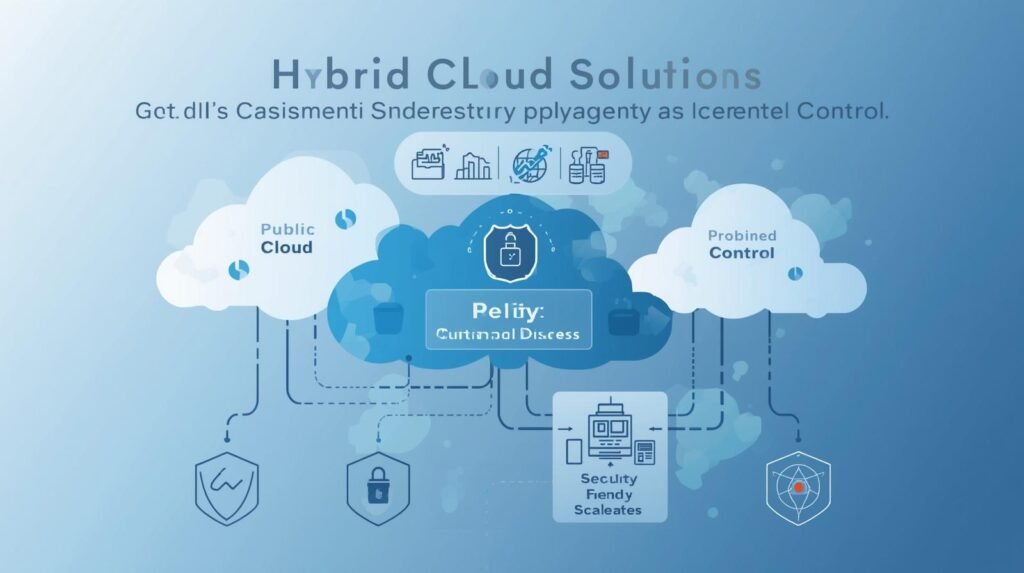
Hybrid Cloud Solutions combine the benefits of public cloud and on-premises (infrastructure). Hybrid solutions offer both the scalability an application may require (on-premises) and the control in areas such as security and regulatory compliance (on-premises), as well as a much lower barrier to entry for migrating legacy applications to a new architecture.
The hybrid solution allows each application to run where it is best suited by the workload characteristics, e.g., sensitive or latency-sensitive applications running close to users and their operations; using the cloud for bursting capacity, advanced analytics, etc. Thus, a company avoids the risk of being locked into a single architecture and avoids “all or nothing” migrations, which can cause significant business disruptions.
An important benefit of Hybrid Cloud Solutions is the increased operational control they afford. Organizations can implement centralized policy management for identity, access, encryption, and compliance across all environments while maintaining localized systems for performance and availability. Moreover, Hybrid Cloud Solutions allow companies to build resilient architectures.
When connectivity is limited, critical services can continue to run locally, while data and log synchronization occur to the cloud upon restoration of network connectivity. For many companies, the hybrid model aligns better with budgetary and operational considerations than either a pure cloud or a pure on-premises model.
In robotics and automation, Hybrid Cloud Edge Robotics provides clear evidence that hybrid models have value. The robot requires immediate responses from perception, safety-stop, and motion-control commands – work that must remain at the edge. However, Hybrid Cloud Edge Robotics uses cloud-scale computing to train, simulate, and analyze fleets of robots, thereby continuously improving models.
Hybrid Cloud Solutions allow users to perform real-time inference near the robot while utilizing cloud-based resources to retrain vision models, utilize a digital twin, and synchronize updates across multiple sites. Achieving a balance between low latency and continuous learning is at the heart of Hybrid Cloud Edge Robotics.
Furthermore, Hybrid Cloud Solutions increase the safety of rollout activities. In a Hybrid Cloud Edge Robotics rollout, updates can be staged and tested against a portion of the device population before monitoring for regressions and then rolling back quickly if necessary. Additionally, data can be filtered at the edge to protect user privacy while minimizing bandwidth used; while cloud-based aggregation produces insights that improve overall system performance – another benefit of Hybrid Cloud Edge Robotics.
The major benefits of using cloud-based services include scalability and adaptability, along with a single point of control and intelligence (Hybrid Cloud Solutions provide this centralization, especially for systems that require both quick response times and large amounts of scalable intelligence; e.g., Hybrid Cloud Edge Robotics).
By combining the cloud-based services provided by each location (centralized in the cloud and localized via edge computing), systems can process information quickly while still taking advantage of the economic scaling available from the cloud.
Therefore, you will process time sensitive, real-time information at the edge (e.g., robots, cameras, sensors, machines); and you will store larger workloads (e.g., analytics, model training, long term storage) in the cloud. Doing so reduces latency, increases reliability, and provides consistent system performance regardless of how well you connect to the cloud.
Another very important benefit of Cloud Edge Solutions is enabling real-time decision making. As opposed to sending all of the raw video, telemetry, and/or LiDAR streams to a remote server where they are processed and then returned; the edge node may perform inference, filter data, and/or take action based upon events/conditions/etc. that occur at the edge. Cloud Edge Solutions can also significantly reduce bandwidth costs because you will only need to transmit what is required (e.g., events, anomalies, summary data, etc.) and/or compressed versions of your original data.
Hybrid Cloud Edge Robotics illustrates a practical implementation of this approach. Robots have millisecond response time requirements for stopping safely, navigating, and controlling movement, and are ideal candidates for an edge execution model. Nevertheless, Hybrid Cloud Edge Robotics relies heavily upon cloud-based learning (training improved perception models; running simulations; comparing fleet behavior at different sites).
Cloud Edge Solutions acts as a kind of glue, enabling organizations to simplify the deployment of common service patterns and distribute those services across multiple geographic regions while pushing new versions into operation, all without disrupting the real-time needs of robotic systems. As a result, Hybrid Cloud Edge Robotics usually implements edge devices for coordination and caching purposes and/or uses the cloud for orchestration and continuous improvement.
Cloud Edge Solutions will support safer deployments and greater operational fault tolerance. Within a Hybrid Cloud Edge Robotics environment, users may prepare model upgrades in advance, track key performance indicators (KPIs), or revert changes if KPI performance worsens. The edge can continue to perform critical functions when the network goes down until synchronization with the cloud can occur again — a valuable capability in high-traffic areas.
The successful use of Cloud Edge Solutions depends upon standardizing observability across both edge and cloud environments, implementing secure methods for identifying devices and verifying authenticity through digital signatures on artifacts, and establishing explicit rules governing what may operate within each layer. Successful use of Cloud Edge Solutions delivers cloud-scale capabilities with the speed of edge computing — just what Hybrid Cloud Edge Robotics needs to be responsive, secure, and continually improve.
The Numbers Behind Edge + Cloud Robotics
[table “285” not found /]Source:
The Dream Team: How Hybrid Cloud and Edge Work Together
The idea behind Hybrid Cloud Edge Robotics is that a robot has one smart brain (edge) for making split-second decisions and another, really smart brain (cloud), for making longer-term decisions. Therefore, there is no reason why a robot cannot get smarter while also getting faster.
One easy way to think about how the edge and the cloud can be used together is by using an example from your own body. Your edge computing is your reflexes. For instance, if you trip over a curb, your arms will flail outward to protect yourself before you’ve even had time to process what happened.
Your edge computing made those immediate decisions. However, once you’ve been protected and have regained stability, then your brain (your cloud) can assess what happened and use that assessment to help prevent you from tripping on the same street again.
This collaboration creates a continuous learning loop. A robot’s edge computer makes hundreds of decisions per second, but when something unusual occurs, such as a new obstacle in front of the robot, it sends that information to the cloud. Then the cloud brain takes that information, determines the best course of action for the new obstacle, and sends it back down to the robot. This type of hybrid cloud architecture provides the opportunity for a robot to continue improving itself.
Ultimately, this hybrid model provides a means for robots to advance past their static programming. With this technology, robots can act as highly responsive dynamic systems. They can rapidly adapt to their surroundings and continually grow more intelligent through experience. Each individual robot can learn from each of its experiences and make improvements to ensure safer operation and greater efficiency within the overall group or fleet.
How Hybrid Cloud Robotics Actually Works
[table “286” not found /]Source:
Three Places You’ll See Hybrid Robotics in Action Today
The Edge-Cloud Partnership combines the power of an Intelligent Edge (or Local) Computing Environment to quickly process Real-Time Data with the vast computing capabilities of a Cloud Computing Environment. Taken together, the Edge-Cloud Partnership will be able to develop new Experiences for People Today, including Cashierless Stores, Autonomous Delivery Drones, and Automated Farming.
Here are just a few of many ways in which the Edge-Cloud Partnership will be used to assist people today;
- Amazon Go stores have developed their own methods, using video cameras and other sensors, to keep tabs on consumers while they shop. Once consumers select a product to purchase, the cameras and sensors at the edge (in-store) quickly transmit data to the Cloud. In turn, once the data reaches the Cloud, the Cloud can charge consumer accounts, adjust the inventory levels of products consumers purchase, and analyze how different products are trending among all consumers who have made purchases at that location.
- Robots are currently being used to increase crop yield for farmers by locating and removing weeds. Robotic systems used by farmers include an onboard camera that uses edge machine learning to immediately determine whether something is a weed. Once the robotic system detects a weed, it removes or destroys it. Additionally, after passing through a field, the robotic system will report to the Cloud the number of weeds removed from each acre. The Cloud then uses that reporting data to formulate the best possible plan to increase the farmer’s crop yields the following day.
- In addition to providing a new type of experience for people, delivery drones are another example of how the partnership of Edge Computing & Cloud Computing is changing the way we live. Although the ultimate purpose of a delivery drone is to safely deliver products/packaging, Edge processors are most interested in quick reaction times when dealing with tasks such as avoiding birds, adapting to changing wind conditions, and responding to a range of other short-term/real-time environmental factors. On the flip side of this equation, the Cloud handles route planning for all drones, ultimately resulting in on-time product delivery and reduced congestion in the air.
Ultimately, separating the immediate and complex tasks of an edge-based (or local) computing environment from those of a cloud-based computing environment enables both the edge and the cloud to operate efficiently and securely.
Real-World Snapshot: Robots in Smart Warehouses
[table “287” not found /]What Happens When the Connection Gets Faster? The Role of 5G
The edge manages the robotic system’s rapid responses but still requires “communication” from the cloud regarding learning, updates, and coordination with other systems. Consider the relationship similar to your poor internet experience during a video conference, where you miss parts of the conversation due to a choppy feed. When multiple robots collaborate, communication delays (latency) will degrade performance and ultimately limit the capabilities of the overall robotic system.
That is why 5G serves as an upgraded roadway, enabling rapid communication between the edge and the cloud. Edge and cloud do not represent either a replacement for the robot’s ability to respond quickly to events or a replacement for the robot’s long-term memory; they merely represent two extremely fast-communicating elements. In edge robotics, 5G offers an enormous increase in bandwidth, enabling a machine to transmit numerous GB of high-definition video for real-time processing and to transmit complex instructions in near-instantaneous time. More specifically, 5G significantly reduces the time lag (latency) associated with this process.
What does this enable? A group of search and rescue robots entering a building after an earthquake could each capture high resolution video of their surroundings and then stream those video feeds to a single location, referred to as the cloud “brain”, while at the same time. The cloud would then use software to create a composite view of the entire area by stitching the videos together to provide a 3-dimensional view of the damage and identify survivors.
The cloud brain would also direct the robots based on this information. While the type of collaboration required to solve problems related to robotics latency in high-risk environments cannot occur without the increased communication speed provided by 5G, it is impossible in a slower network environment.