















Many people believe that their credit scores do not fully represent their financial stability. Since the advent of credit scores, it has become clear that a person’s ability to accomplish large-scale life events, such as buying a house or starting a business, largely depends on a single number (i.e., their credit score). While the original way to determine credit scores (the FICO model) has enabled many people to succeed over time, this model can overlook other important components of an individual’s overall financial wellness.
A possible illustration of this is that you’re consistently making your rent payments on time and have done so for years, but your consistent rental payment record will have little or no effect on your credit score. Another example could be being a freelancer, which provides a stable source of income. However, the history of your income may appear unstable in a traditional credit-scoring model.
According to industry data, millions of financially responsible consumers are denied access to affordable credit because their financial history does not fit within the limited categories used in most traditional credit scoring models. In addition, the exclusionary effects of traditional credit scoring models tend to disproportionately affect younger consumers, immigrants, and others who earn money in non-traditional ways (e.g., through the gig economy).
Wouldn’t it be great to have alternative credit scoring models that were both fairer and more modern than traditional credit scoring models? That is exactly what some companies that use advanced Artificial Intelligence (AI) credit-scoring models are trying to create. Advanced AI credit-scoring models focus on much more than just a history of repaying debts and take into account many factors about an individual to provide a better understanding of their overall financial health and stability.
Summary
This article explains how Artificial Intelligence (AI) is being utilized to make better, more modern lending decisions through Credit Scoring. Prior to this technology, Credit Scores were developed using at least part of an individual’s entire Credit History – Payment History, Amount Owing, Length of Time with Credit, Inquiries within the last few months, Types of Credit Used and/or Applied For – to determine if an applicant was eligible for a loan.
However, prior methodologies may miss important aspects of a potential Borrower’s Financial Picture, particularly for those who do not fall into one of the categories listed above (Renters, Freelancers, Young People, Immigrants), because they would likely be categorized as having a “Thin” Credit File.
The Article provides information on how Machine Learning is used by AI to identify Trends in previously issued Loans and to provide a much more Detailed, Forward-Looking view of the Risks associated with making Lending Decisions.
Additionally, the Article notes that AI is able to incorporate “Alternative Data”, which is excluded from Old Scoring Systems when assessing Credit Worthiness (On-Time Rental and/or Utility Payments, Cash Flow from your Bank Account, etc. and other Stability Indicators), thus creating a Predictive Form of Credit Scoring that focuses on a Borrower’s Ability to Make Loan Repayments in the Future Rather Than their History of Borrowing in the Past.
#Transformative AI for Clinical Decision: Empowering Doctors to Think Faster
The author then addresses one of the most significant problems with the use of AI-based systems to evaluate the creditworthiness of individuals: they inherit biases and discriminatory practices from the historical lending data they use and can be biased through indirect means (e.g., using an individual’s zip code) to the same extent.
The author recommends that to prevent this, the AI-based credit-scoring system should include provisions for fair testing, provisions for explanations regarding how each decision was made (“explanatory AI”), and regulatory oversight of the design and implementation of AI-based credit-scoring methods under existing laws (such as the Equal Credit Opportunity Act).
In summary, the authors state that the use of AI-based systems to evaluate an individual’s creditworthiness may lead to increased access to financing, provide more realistic second-chance opportunities for those who have experienced previous difficulty in obtaining funding, and significantly reduce the time needed to make a loan decision; but, these benefits will only occur when there is sufficient transparency and regulation over the creation of AI-based systems to determine an individual’s credit-worthiness.
The Old Recipe: What Your Traditional FICO Score Sees (and What It Misses)
Traditional credit scores – think of them as a recipe for success – the most common recipe is based on a formula developed in the 1950s and still used today to evaluate your financial history using only five key ingredients:
1. Paying bills on time
2. The total amount you owe
3. The length of time that you have been using credit
4. The number of new applications you have made for credit
5. The mix of credit types (cards, loans, etc.)
While this outdated process for creating recipes may look back, the way we create recipes currently is also looking at how you used debt in the past. This is why a FICO credit score is essentially a report of how you’ve used debt in the past. As such, the historical approach to creating recipes has not taken into account all the factors in your current financial situation.
In fact, many people manage their finances well, but because of the traditional recipe’s historical nature, they are excluded from the conversation. An example would be a recent college graduate who is employed in a stable position, but has no experience with credit cards. Another example could be a freelance worker who earns an average amount each month, but has irregular income.
Both these examples would be considered to have “thin” credit files. In both cases, they lack the required number of key ingredients to make the traditional recipe. However, as responsible adults, they are financially capable. Thus, AI can provide a broader view to improve financial inclusion.
From FICO to AI: What Really Changed?
| Aspect | Traditional Credit Score | AI Credit Scoring | Real Impact |
|---|---|---|---|
| Data Used | Credit history only | Multi-source data | More inclusive |
| Analysis | Static rules | Dynamic models | Better accuracy |
| Updates | Periodic | Real-time | Faster decisions |
| Coverage | Limited users | Wider population | Financial inclusion |
Source:
AI Credit Scoring: AI evaluates borrower risk using intelligent data analysis
Lenders are moving away from relying on a narrow set of common credit factors when making lending decisions; instead, they will use a variety of data points to evaluate applicants’ creditworthiness using artificial intelligence (AI). These AI credit scoring systems combine traditional credit scoring factors (credit payment history, credit usage) with other permissible signals, then apply machine learning algorithms to identify relationships among these data points and assess how well they predict the likelihood of repaying a loan.
The ultimate goal is to have a faster, more uniform way of assessing a borrower’s ability to repay by providing a more accurate view of their current financial status.
AI credit scoring cleanses and formats all input data, handles missing values, and generates new feature variables from the existing input data (for example, generating stability metrics for evaluating income based on when it was received and trend metrics for previous account behaviors, such as account balance or activity).
AI credit scoring trains its models on historical data on defaulted loans to determine the likelihood of future delinquencies, defaults, or repayment. The trained model then adjusts the scores to clearly represent an easily understood level of risk.
Once the models are implemented, AI credit scoring models are continually evaluated for signs of “drift,” including shifts in consumer behavior or economic conditions that may cause the model’s performance to decline without notice.
one of the primary promises of ai credit scoring is to improve lender decision-making processes. AI in credit scoring could potentially allow lenders to make lending decisions in a more consistent manner than humans, while also increasing lending opportunities for consumers who do not have sufficient credit information (“thin files”) if AI credit scoring can identify valid indicators of an individual’s ability to repay.
Although numerous mechanisms exist to govern AI Credit Scoring to mitigate the further widening of existing disparities in access to credit, lenders can take steps to ensure that does not happen. For example, lenders must be responsible for protecting data and ensuring that prohibited features (e.g., race, sex) are removed from the models they use to score applicants.
Lenders must also frequently evaluate whether these systems create disparate outcomes. Lenders must also develop methods to explain to the applicant, in simple terms, how the model produced the decision made about the applicant. Finally, lenders must periodically audit their models.
Additionally, lenders must provide consumers whose applications have been rejected with an explanation of the reasons for rejection that is understandable and clearly stated. Lenders must also protect the confidentiality and privacy of consumers’ personal information as required by federal or state law.
Lenders will gain some important benefits from using AI Credit Scoring, such as: faster approval of loans; improved accuracy of pricing of loans; earlier detection of possible problems, which allows lenders to establish credit limits and interest rates more accurately, and to initiate review of potential borrowers’ repayment performance in a more timely manner.
Borrowers may also benefit from AI Credit Scoring, as it could enable quicker loan approvals. In addition, AI Credit Scoring may allow borrowers to qualify for credit where traditional methods would deny them due to a lack of sufficient compliance with lending standards, by utilizing compliant alternative data to better assess the likelihood of repayment.
The Master Chef’s Approach: How AI Creates a 360-Degree View of Your Finances
The AI credit model is designed to work like a master chef who learns a new culinary style, rather than just following a list of instructions. Instead of a fixed recipe to follow, the AI credit model examines thousands of previous loans to see which ones paid off and which didn’t. Additionally, using machine learning, the AI credit model identifies hidden behavioral patterns that might have gone unnoticed by a formula-based model.
The AI credit model uses a combination of both past financial experience and other factors, or “features”, that help build a picture of what makes someone likely to repay a loan.
These “features” can include the applicant’s employment history, rental payments, utility payments, net inflow into bank accounts, etc. As experts note, this allows the AI credit model to tell a complete “story” about the applicant’s financial status rather than focusing solely on their debt.
Thus, the use of AI credit scoring marks a significant departure from traditional methods based on past performance and moves toward assessing an applicant’s future potential. With the capacity to review a wide array of past financial data and evaluate it holistically, the AI credit model can generate an educated estimate of the applicant’s likelihood of repaying the new loan — known as predictive credit scoring.
Therefore, while the AI credit model used to focus primarily on an applicant’s prior activities, today it looks at where the applicant is headed financially. And because of a larger amount of financial history than before, the AI credit model has a greater understanding of an applicant’s overall financial position.
And finally, in addition to reviewing an applicant’s financial history, the AI credit model also considers how well the applicant manages their finances to improve the accuracy of predictions about whether they will meet their repayment obligations.
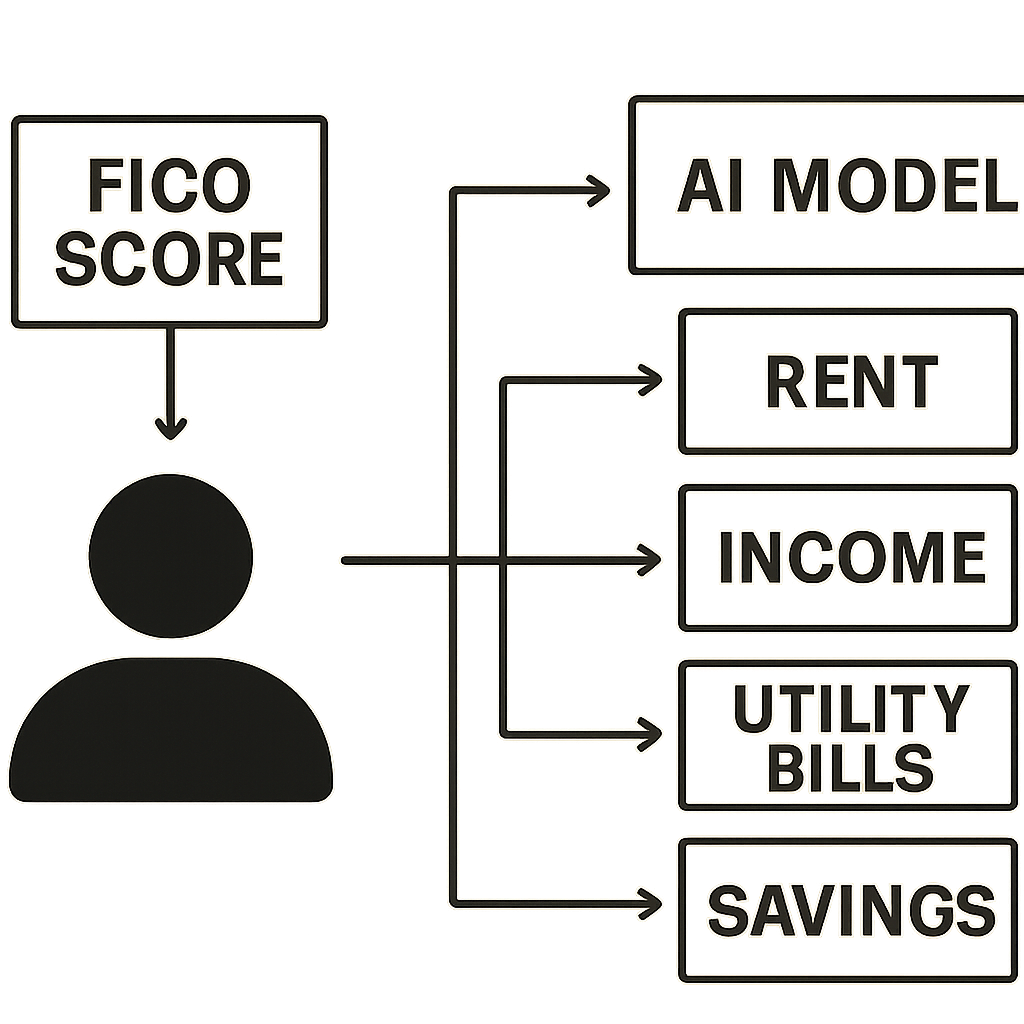
Advanced Credit Analysis: Advanced analytics improve credit evaluation accuracy

Advanced Credit Analysis is changing the way lenders evaluate creditworthiness by leveraging additional data, improved statistical methods, and faster decision-making.
In contrast to evaluating creditworthiness based on a few key indicators, Advanced Credit Analysis evaluates borrowers based on historical trends — specifically income and expense stability; account usage history; payment history; and early warning signals of possible financial distress — allowing lenders to differentiate one-time changes in borrower payments from longer-term underlying risk.
When combined with good governance, Advanced Credit Analysis enables lenders to make more accurate assessments of credit risk and lend consistently across very large portfolios of borrowers.
Machine Learning and the need for rigorous validation have been the most important drivers for Advanced Credit Analysis. Machine Learning models use historical data on the repayment performance of all previous loans to develop the model, test it against “hold-out” samples, and simulate stress tests under different macroeconomic conditions.
This is generally the domain of AI Credit Scoring: exploring interactions among individual variables, identifying potential or new predictors, and continuously adjusting the lender’s perception of each borrower’s credit risk as the borrower continues to behave.
The Advanced Credit Analysis also includes developing detailed designs of the feature(s) used in the analysis (for example: calculation of volatility; rolling averages); calibrating the band limits around scores; and conducting ongoing surveillance of Model Drift (the degree to which models change over time) — so that the lender understands if they still trust their systems as the market place changes.
Advanced Credit Analysis increases the accuracy of credit assessments, helping lenders improve loan segmentation and pricing through advanced analytical capabilities. With Advanced Credit Analysis, lenders can set different credit limits, rates, and review requirements for each applicant based on that applicant’s risk profile. The result is a reduction in losses to the lender from loan defaults, as well as tighter credit standards for everyone.
In addition, Advanced Credit Analysis enables faster loan application processing by automating underwriting and prioritizing applications for human review. As such, lenders can quickly approve loan applications when large volumes are submitted (e.g., at the end of the month).
With Advanced Credit Analysis, lenders can also consider permissible alternative signals and trend data when evaluating a consumer’s ability to repay a loan, especially when the consumer has very little borrowing history (thin file) or is new to banking. Thus, with Advanced Credit Analysis, lenders can evaluate a consumer’s credit more fairly and transparently than with traditional methods.
To ensure trustworthiness, Advanced Credit Analysis requires transparency and auditability. For example, lenders will need to obtain an explanation code for the reasons for a credit denial, the data used to assess creditworthiness, testing for bias and disparate impact on protected classes, and regular performance reporting. If lenders establish the necessary controls around how AI Credit Scoring is used, then AI Credit Scoring could be a valuable part of an overall risk management strategy, rather than simply a “black box” decision-making system.
Therefore, when executed properly, Advanced Credit Analysis and AI Credit Scoring enable lenders to make more accurate, faster, and less disruptive credit decisions for both lenders and qualified borrowers.
Credit Risk AI: AI predicts the likelihood of loan default

Credit Risk AI allows lenders to evaluate how likely consumers are to pay back their debts, and turn large amounts of complicated information about consumers into simple numbers – or risk estimates – to make lending easier and faster. Credit Risk AI provides lenders with a dynamic way to analyze consumer behavior and trends (including payments, cash flow, and other early warning signs) when assessing whether to lend to a consumer.
This results in lenders making better decisions than they would have made without Credit Risk AI. In addition, because Credit Risk AI validates lenders’ decision-making, it helps reduce the likelihood of different lenders making different decisions regarding the same applicant.
An example of how Credit Risk AI works is through algorithms and machine learning. Credit Risk AI analyzes and models all characteristics associated with the borrower (as well as prior performance metrics), including, but not limited to, past delinquencies, charge-offs, and cure rates.
Data is then cleaned, normalized, and prepared for feature engineering (volatility scores, trend indicators, etc.) in order to build features. These features are then trained and calibrated on top of models so that the final model produces output that falls within a defined risk band.
Many lenders use AI Credit Scoring as a client-facing representation of the Credit Risk AI process; AI Credit Scoring converts predictive signals generated by Credit Risk AI into a number/ rating that lenders can use to determine if to fund a consumer application, how much to fund, what terms should be used (i.e., interest rate), etc. Overall, Credit Risk AI and AI Credit Scoring allow lenders to move from “yes/no” lending models to a lending model in which each applicant receives a risk-segmentation score.
Operational capabilities provided by Credit Risk AI include enabling lenders to approve loans and manage their loan portfolios more efficiently. Credit Risk AI also enables lenders to utilize predicted default probabilities to qualify applicants for funding and to determine loan terms based on an applicant’s risk level. Finally, lenders can communicate directly with consumers who have experienced a decline in creditworthiness since their last assessment.
Credit Risk AI will enable lenders to automatically approve lower-risk applicants and route borderline applicants to the appropriate lender for assessment and evaluation. Additionally, the system will maintain records of all decision-making rationale that support a lender’s determination to accept or reject an applicant.
Throughout the term of a loan, Credit Risk AI can assist lenders in continually tracking how well borrowers perform amid changing economic conditions and shifts in borrower behavior. It is imperative that models used to assess a borrower’s need for credit be continually evaluated and retrained (recalibrated) so they continue to accurately represent a borrower’s potential for repayment and, therefore, the ability to repay the borrowed funds.
There are many regulatory concerns regarding the use of AI in making credit decisions, since these decisions have such a significant impact on consumers. As such, Credit Risk AI should contain safeguards against the inclusion of prohibited variables in the analysis, ensure the protection of consumers’ personally identifiable information and other consumer data, and include testing for disparate impact (i.e., whether AI Credit Scoring systems treat different demographic groups unfairly).
Additionally, methods that enable explainable outcomes and clearly document the reasons an AI Credit Scoring system took an adverse action will help ensure that AI Credit Scoring Systems are understandable and compliant.
Predictive Credit Scoring: Predictive models forecast future borrower behavior

Predictive Credit Scoring evaluates a customer’s probability of making payments on his/her debt(s), with the use of Statistical Models, Machine Learning, and Predictive Modeling.
Unlike Traditional Credit Scoring Methods that look at your credit profile at one given moment in time, Predictive Credit Scoring uses a combination of your entire credit history, which may include trends in payment history, the way you have utilized available credit, changes in your credit mix, etc. to give a better picture of where you stand financially and predict whether or not you will be able to repay your debts when due.
If performed correctly, Predictive Credit Scoring enables lenders to make more informed, consistent, and timely lending decisions based on a borrower’s past and present behavior.
To begin developing a Predictive Credit Scoring Model, the first step would be to obtain and organize all relevant data for analysis. This would include obtaining traditional Bureau Variables, as well as permitted internal data under applicable laws, such as Account Activity, Transaction Details, and Repayment Histories.
The next step is to engineer features from the collected data to evaluate if there is a specific trend or pattern within the data (i.e., “has the customer increased their credit utilization by $1000 for six consecutive months”, or “have the deposits made into the customer’s bank account become less consistent”).
Once the features have been engineered, they can be used to train a model using previous outcomes. There are many ways to apply Predictive Credit Scoring today, but most commonly through Artificial Intelligence Credit Scoring (AI Credit Scoring). AI Credit Scoring is primarily used to identify relationships between multiple variables and to provide updated risk profiles for each individual customer.
Therefore, unlike Traditional Credit Scoring, Predictive Credit Scoring is not limited to loan origination; it can also be used during the loan term to forecast potential changes in the customer’s risk profile.
Predictive Credit Scoring allows lenders to better target the right customer at the right price. This means lenders can establish credit limits, pricing, and approval guidelines for new customers based on their predicted risk level, so that overall losses are minimized, and no customer is denied a loan due to overly restrictive lending terms.
In addition to enabling lenders to make faster loan approval decisions by automatically approving loans for low-risk borrowers and manually reviewing borderline cases, AI Credit Scoring also allows lenders to proactively monitor their customer portfolios. For example, lenders may use early warning systems (e.g., reminders, hardship programs) to address issues before they develop and maintain positive customer relationships.
As such, AI Credit Scoring does not simply provide lenders with a tool for evaluating the creditworthiness of new applicants. It also serves as a resource to assist lenders in managing ongoing customer relationships and monitoring the risks inherent in those relationships.
The importance of governance cannot be overstated when using predictive credit scoring, since these tools can affect large numbers of consumers. Therefore, lenders must continually audit and validate the performance of the predictive credit-scoring models they use. Specifically, predictive credit scoring models must be continuously monitored for “drift” (changes over time) and tested to validate their accuracy during different economic periods.
Testing must also be performed to evaluate whether the predictive credit-scoring models used by lenders have disparate effects on certain consumer populations.
Lenders that provide transparent explanation for each applicant’s decision (for example, providing a clear reason for denial of a loan) will enhance the transparency and regulatory compliance of AI Credit Scoring. Additionally, AI Credit Scoring that uses data protection protocols for consumers will further enhance the responsibility with which lenders forecast their customers’ future behavior.
The Numbers Behind AI Credit Scoring
| AI credit models can improve prediction accuracy by 20-30% |
|---|
| Millions of "thin-file" users gain access to credit |
| Loan decision time reduced from days to minutes |
| Financial inclusion significantly increases with AI models |
Source:
Machine Learning Credit: Machine learning improves scoring models over time

Predictive Credit Scoring allows lenders to better identify how to segment their products and how much to charge. Therefore, they can establish credit limits, interest rates, and approval thresholds that account for the expected loss risk for each applicant. In turn, this reduces the total amount lost through bad debt, but does so without restricting access to credit by tightening lending standards.
Moreover, AI Credit Scoring facilitates the rapid processing of numerous credit applications by automatically approving low-risk applicants and referring borderline cases for human review. Finally, predictive credit scoring may also be used to facilitate active portfolio management over time (e.g., proactively developing early warning systems, sending customer reminders, offering hardship alternatives, etc.), thereby preventing serious problems before they occur.
Consequently, predictive credit scoring technology may serve not only as a tool for credit underwriting but also as a means of providing ongoing support to customers throughout the relationship life cycle.
Because predictive credit scoring technology has direct implications for consumers who use credit services, governance issues related to its development and deployment are very important. Specifically, predictive models built using predictive credit-scoring technology should be continuously tested for ‘drift’ (i.e., changes in the models’ predictions over time).
Furthermore, these models should be periodically validated across a variety of different economic environments. And finally, the developers of predictive credit-scoring technology should test whether its application results in disparate treatment of different groups of people. Tools that provide transparent explanations of the rationale behind automated decisions (thereby enabling users to understand what influenced the outcome of a particular decision) will improve the governance of AI Credit Scoring technology.
Similarly, combining AI Credit Scoring with well-developed consumer data protection policies, along with regular audits, will create a framework in which both predictive credit scoring and AI Credit Scoring can be used responsibly to forecast future behavior, while enhancing forecast reliability and promoting accountability in making those forecasts.
Machine Learning Credit has a number of long-term advantages, including the ability to adapt over time. Because lending portfolios continue to expand and new information about the borrower’s repayment history becomes available, the models used in Machine Learning will need to be periodically validated as a result of changing fraud patterns, the emergence of new financial products, and other factors that can cause model drift.
These repeated validations also contribute to consistent and accurate results for AI Credit Scoring through the ongoing evolution process.
Machine Learning Credit also provides lenders with improved capabilities to make better operational decisions, such as automating approval of low-risk applicants, manually reviewing high-risk applicants, and flagging potential risks related to an applicant’s current credit relationship before extending additional credit.
Governance of the creation, implementation, and ongoing use of Machine Learning Credit is required. Documentation of the lender’s data lineage, protection of the applicant’s private information, and audit trails for compliance will help ensure that the lender’s models do not use prohibited attributes or proxy variables that could result in discriminatory treatment of loan applicants.
Lenders should continually test the fairness of their models, monitor their performance, and provide transparency into how their models arrive at a particular determination (such as reports on feature importance and/or the reasons for that determination).
Combining these three methods will enable lenders to create and support AI Credit Scoring solutions that are both transparent and defensible with adequate oversight. Additionally, when combined with adequate oversight, Machine Learning Credit allows lenders to continually update their scoring models, manage risk more effectively, and provide qualified consumers with more accessible and predictable credit.
Credit Scoring Technology: Technology enhances fairness and transparency in lending

Modern Credit Scoring Technology uses better methods of managing data, better models for governing how those models are created and applied, and provides lenders and consumers alike with a clear understanding of which factors were considered when deciding whether to lend money to a consumer, based on the consumer’s own factors.
Credit scoring technology also helps reduce the need for arbitrary or subjective judgments made by underwriters about creditworthiness, while providing for consistency and uniformity of lending decisions across multiple geographic areas (branches), delivery mechanisms (channels), and underwriting groups.
A primary advantage of using today’s Credit Scoring Technology is that it can track a consumer’s past payment history and the frequency of credit use, and identify trends that indicate potential future financial problems. These are tracked and converted to risk assessment measurements. As such, this is a possible way that AI credit scoring could be utilized.
By using machine learning, AI credit scoring can analyze large datasets to identify and quantify complex relationships, estimate the likelihood of specific risks, and enable faster lending decisions. However, typically, AI Credit Scoring is incorporated into larger Credit Scoring Technology platforms.
Those platforms include data pipelines that collect consumer data, validation checks that verify the accuracy of the collected information, and policy-based rules that convert the output from AI Credit Scoring into loan terms (approved amount, interest rate, etc.).
Fairness and Transparency in a Credit Scoring System go beyond accuracy. A good Credit Scoring Technology will include important features such as testing for bias and disparate impact, and tools to prevent prohibited (or close proxies) variables from influencing the lender’s decision outcome. It will also provide lenders with clear reason codes and easy-to-understand summaries of why the borrower was approved or denied, and what steps he/she needs to take to possibly be considered for approval in the future.
Explainability is very important for developing useful AI Credit Scoring technology and for creating understandable and auditable model results. When an organization develops explainability into its Credit Scoring Technology, the insights from the model are rational for customers and ready for use in decisions.
Another major component of Credit Scoring Technology is monitoring activity. The technology allows organizations to monitor how their models perform; identify when changes in underlying economic conditions occur, causing “drift” in the data; and alert them to update and retrain their models to produce consistent results.
This ensures that the continued reliance on AI Credit Scoring systems remains reliable over time and that users do not unknowingly allow these systems to fail or inequitably affect portions of society. By incorporating Privacy, Security, and Auditing into Credit Scoring Technology, organizations may develop High Standards for Responsible Lending Practices, making AI Credit Scoring not only more effective for Risk Management but also more transparent for Consumers.
More Than Debt: The ‘Alternative Data’ That Can Unlock a Loan
Fairness and Transparency in a Credit Scoring System go beyond accuracy. A good Credit Scoring Technology will include important features such as testing for bias and disparate impact, and tools to prevent prohibited (or close proxies) variables from influencing the lender’s decision outcome. It will also provide lenders with clear reason codes and easy-to-understand summaries of why the borrower was approved or denied, and what steps he/she needs to take to possibly be considered for approval in the future.
Explainability is very important for developing useful AI Credit Scoring technology and for creating understandable and auditable model results. When an organization develops explainability into its Credit Scoring Technology, the insights from the model are rational for customers and ready for use in decisions.
Another major component of Credit Scoring Technology is monitoring activity. The technology allows organizations to monitor how their models perform; identify when changes in underlying economic conditions occur, causing “drift” in the data; and alert them to update and retrain their models to produce consistent results.
This ensures that the continued reliance on AI Credit Scoring systems remains reliable over time and that users do not unknowingly allow these systems to fail or inequitably affect portions of society. By incorporating Privacy, Security, and Auditing into Credit Scoring Technology, organizations may develop High Standards for Responsible Lending Practices, making AI Credit Scoring not only more effective for Risk Management but also more transparent for Consumers.
• Payment history with regard to rent
• Utility bill payments (such as electricity or phone) made in a timely manner
• A consistent and positive cash flow from a bank account
• Education and/or employment history
With this data showing that an individual has consistently made timely rental payments year after year, we recognize they have been responsible in paying their bills. As this type of information is used as input in machine learning models that evaluate loan applicants, these systems will clearly see an applicant’s history of financial responsibility (and therefore lower risk) when no long-term credit history is available.
This additional data provides a better understanding of the artificial intelligence model, but introduces another risk: what happens to the model’s quality when the historical data used to develop/train it contains inaccuracies?
Real-World Example: AI Expanding Credit Access
| Case | Upstart |
|---|---|
| Uses AI + alternative data (education, employment) | |
| Approves more borrowers than traditional systems | |
| Maintains risk levels comparable to traditional models | |
| Impact | Increased loan approvals |
| Reduced bias in lending decisions |
Source:
Vendor’s Advanced AI Credit Scoring Integrated Tax Investment Bureau Data: Vendors use advanced AI credit scoring by integrating tax, investment, and bureau data for deeper risk assessment

Vendor’s Advanced AI Credit Scoring, Using Tax Investment Bureau Data – This is a vendor-driven lending model that utilizes multiple verified sources of data to create a more complete picture of the level of risk presented by all borrowers.
By linking a potential borrower’s bureau credit history with select tax and investment information (so long as it is lawful to do so and they have provided consent), lenders can obtain a much better understanding of each potential borrower’s stability, capacity, and resilience. This allows lenders to better evaluate potential borrowers when limited information is available about the individual or when income and/or asset levels fluctuate over time.
In addition to combining bureau data (for example, usage, payment history, etc.), Vendor’s Advanced AI Credit Scoring Using Tax Investment Bureau Data may include additional data points (e.g., income volatility, reporting liability trends, directionality in investable assets, etc.) that would need to be evaluated individually in a separate process.
In general terms, the vendors convert these inputs into time-based feature sets (i.e., volatility and directional trends); apply predictive modeling techniques to estimate desired outcomes (i.e., likelihood of delinquent status); and utilize the integrated data set to generate additional “ranking” power – identify not just those individuals who are at a high risk, but also what factors may be influencing the increase/decrease in risk.
Having access to more data does not inherently equate to making better decisions. As such, the vendor’s advanced AI credit scoring, using Tax Investment Bureau data, will require strong governance practices to ensure that only compliant, relevant, and understandable variables are used in decision-making processes.
In addition, the lender will need to have the vendor’s Advanced AI Credit Scoring and the Integrated Tax Investment Bureau Data clearly documented to show all required permissions. The lender will also need to verify that the vendor has met the lender’s Privacy, Security, and Regulatory Compliance requirements before integrating its Advanced AI Credit Scoring and the Integrated Tax Investment Bureau Data.
The Vendor’s Advanced AI Credit Scoring and Integrated Tax Investment Bureau Data can provide lenders with documentation for model validation, model drift monitoring, and fairness testing, ensuring that this system does not produce unintentional disparate effects.
Additionally, Vendor’s Advanced AI Credit Scoring and Integrated Tax Investment Bureau Data can help lenders make more accurate decisions on approval levels, interest rates, and loan amounts, and enable them to achieve greater consistency across channels. Furthermore, Vendor’s Advanced AI Credit Scoring and Integrated Tax Investment Bureau Data enable lenders to provide consumers with more detailed and auditable adverse action messages by producing clear, specific reason codes based on risk drivers.
Therefore, when appropriately controlled, Vendor’s Advanced AI Credit Scoring, in conjunction with the Tax Investment Bureau Data, may offer lenders a practical solution for evaluating creditworthiness and balancing the needs of predictive performance, transparency, and consumer confidence.
What Data Feeds AI Credit Scoring?
| Data Type | Example | Why it matters |
|---|---|---|
| Credit Bureau | Loan history | Traditional risk |
| Banking Data | Transactions | Spending behavior |
| Alternative Data | Utility bills | Inclusion |
| Tax Data | Income records | Financial stability |
| Investment Data | Assets | Risk assessment |
Source:
The AI’s Blind Spot: How Can a Smart Machine Be Biased?
The issue with AI isn’t how intelligent it is; it is how it is educated. Mirrors are unaware of being mirrors, and AIs don’t know they’re AIs either. An AI reflects the world as it was instructed; if the world the AI learned about contained several decades of inequitable lending, that would be reflected through those same inequities. That is why we call these biases algorithmic. The AIs didn’t intentionally discriminate; they merely replicated past errors in a new format that includes today’s technology.
An AI can find many different types of patterns when looking over millions of previous loan application files and determine that, based on “patterns,” individuals living within certain areas had significantly more denials than all other locations. Unfortunately, unless the AI recognizes that these denials are rooted in redlining and other outdated, discriminatory lending practices, it could incorrectly conclude that individuals living in that area are at higher risk of loan defaults.
In an effort to eliminate this type of issue, developers attempt to restrict the AI’s ability to make decisions using protected classes such as race and/or gender. However, restricting the use of protected classes creates another potential problem. For example, an AI may recognize a pattern between a specific zip code and loan defaults. The zip code also contains a large number of residents in that community.
Although there seems to be no indication of racial or ethnic components to the AI’s decision, it has actually identified a surrogate for the original discriminatory practice. This is called proxy discrimination and is one of the largest hurdles to creating a fully equitable and fair AI system.
Building an Ethical Compass: How We Make AI Credit Scoring Fair
Developers use Fair AI in their development process to ensure that an AI system is developed with fairness being at least one of the many goals. To assess whether a developer has built a fair AI, the developer is required to run the same test on the AI multiple times throughout the development stage. This allows them to see if the AI may favor some data over others. For example, using a zip code that can possibly link to someone’s race or gender.
Fair AI is used so that a developer can build an AI that makes decisions based solely on an individual’s financial behavior and does not perpetuate prior inequality. However, in addition to building an AI that is designed to be fair, there also needs to be evidence that proves the AI is indeed making decisions fairly. That is when explainable AI comes into play. Explainable AI (XAI) is like having an AI demonstrate its work. As opposed to getting a simple “yes” or “no” answer from an AI, an XAI demonstrates, step by step, exactly why it made the choice it did.
For example, if an Artificial Intelligence (AI) approves a loan based upon the applicant having a consistent history of timely rental payments as well as a history of a steady income for a long period of time, then the eXplainable AI (XAI) would explain the decision-making process for the approval by pointing out that the applicant’s history of making timely payments on rental property as well as the applicant’s history of being employed; were used as the bases for making this determination.
In addition to using technical safeguards to prevent an AI from discriminating against an individual, federal and state laws prohibit discriminatory practices in extending credit. An example of this type of law is the Equal Credit Opportunity Act (ECOA).
This law prohibits creditors from denying a credit application or charging an applicant different interest rates based on certain characteristics. The prohibited characteristics under this law include an applicant’s race, color, religion, national origin, sex, marital status, age, or receipt of public assistance. In addition to the federal ECOA, many states have passed their own versions of the ECOA, which govern how creditors may discriminate when extending credit.
Since the ECOA-type laws were passed before the development of AI technology applicable to the lending industry, regulators required lenders to demonstrate that the AIs they use to make credit-application determinations do not discriminate and comply with all relevant laws and regulations. Therefore, there is another layer of human oversight in lenders’ use of AI in the lending industry.
Together, active fairness testing, XAI, and regulatory oversight form a triangle of balance intended to create a credit scoring system that is both more accurate than existing systems and more equitable.
Fair or Biased? The AI Credit Decision Compass
| Principle | Why it Matters | Risk if ignored |
|---|---|---|
| Fairness | Equal opportunity | Discrimination |
| Transparency | Explain decisions | Lack of trust |
| Accountability | Responsibility | Misuse |
| Privacy | Protect data | Breaches |
| Auditability | Monitor models | Hidden bias |
Source:
What AI Credit Scoring Means for You: More Approvals, Fairer Chances
For countless individuals, this new paradigm opens up possibilities that had been heretofore unexplored. The AI can now consider a multitude of additional criteria (i.e., rental history, consistent bank deposits, etc.) as part of its evaluation of your overall financial situation.
Financial inclusion is defined as providing access to financial resources in a manner that is fair.
With the advent of AI, this ideal is no longer merely theoretical. If you have recently graduated from college with a great job but have not had the opportunity to obtain a credit card, or you are a reliable renter who consistently makes timely rent payments but has never had those payments taken into consideration when evaluating your creditworthiness, an AI can evaluate your financial stability and give you the “yes” you deserve.
A new AI-based method of evaluating credit-worthiness provides a much more realistic way for someone to receive a second chance. Credit reporting agencies’ traditional methods of assessing an individual’s credit-worthiness emphasize past transgressions that may negatively affect an individual for many years.
On the other hand, an AI-based credit assessment method allows for greater emphasis to be placed on the positive actions you are currently taking. For example, if you have consistently paid all of your bills on time for the last year, an AI-based assessment can weigh that action as more positive than a late payment you made five years ago.
An AI-based method of assessing creditworthiness is also far more rapid than traditional methods. Instead of waiting for what could be several days for a loan officer to manually review your file, an AI can make a decision in mere minutes. By removing the necessity of manual evaluations by loan officers, the AI-based method of assessing creditworthiness eliminates much of the uncertainty and anxiety that accompany applying for credit.

What AI Credit Scoring Means for You
| Situation | Traditional Outcome | AI Outcome |
|---|---|---|
| No credit histroy | Rejected | Considered |
| Low score | High interest | Fairer rate |
| Gig worker | Ignored | Evaluated |
| Fast loan need | Delayed | Instant decision |
Your Financial Story, Reimagined: How to Thrive in the New Era of Credit
Credit risk assessment has evolved from using a single static score to represent someone’s entire financial history to assessing each person’s financial history in a much more dynamic and holistic approach.
By evolving from scoring a person with a single number that represents their entire financial history to providing a full financial history of who you are, you’ll have more options for how to share your financial history. To help ensure your financial history is represented fairly in this new assessment process, start building your own financial history now by completing the two easy steps below:
1. If your landlord offers a rent reporting service, ask them if they do. This will allow you to get credit for paying your rent on time.
2. When applying for lending services through a modern lender, use a third-party application like Plaid to connect your bank account to theirs. This will enable the lender to see your income.
These two actions will give the lender(s) a better understanding of your total financial situation therefore enabling greater financial inclusion for everyone. The future of credit isn’t about hiding your past; it is about recognizing both your present and future potential. What is a fairer and more honest way to express the story of your financial history?
Conclusion
AI has become an increasingly important tool used in credit lending. Fair & Advanced AI Credit Scoring represents a different way of evaluating potential borrowers’ ability to repay loans. The use of machine learning to evaluate a wide variety of factors, such as rent and utility payments, income, and positive cash flow, creates a complete picture of an applicant’s overall financial situation.
This enables lenders to make better evaluations of applicants without a traditional credit record, allowing them to lend to people who would otherwise be excluded from credit. Additionally, this process could enable lenders to provide fast, consistent loan applications and focus on recent credit behavior rather than long-term credit history.
The “advanced” portion of this system will only be as fair as its design. If the designers do not build fairness into the system, then there is nothing preventing the AI system from continuing to create systemic inequality through a proxy.
To prevent this outcome, the development team must implement safeguards to ensure that the system is designed and operates fairly. Examples of safeguards include selecting relevant data points, testing for bias/disparate impact, providing reasoning for lending decisions, and continuously monitoring how lending decisions are made over time.
It is therefore obvious that lending decisions will be smarter and more equitable if vendors/lenders prioritize fairness, transparency, and oversight in their lending products.
FAQs
- What is AI credit scoring?
The use of machine-learning algorithms in the field of artificial intelligence (AI)-based credit scoring represents an improvement over conventional methods for assessing borrower risk by leveraging historical loan performance and a broader scope of financial data than traditional credit scoring. - How is it different from a traditional FICO-style score?
The primary focus of traditional credit scoring has been credit bureau history, including payment history, debt, length of time since opening your first account, number of recent inquiries on your credit report, and the types of credit accounts you have established. The use of alternative data provides lenders with additional permissible sources beyond traditional credit reporting (e.g., rent and utility payments and bank cash-flow patterns) to obtain a more comprehensive picture of potential borrowers. - What is “alternative data,” and who benefits from it?
Alternative data refers to financial information that may not be reported in traditional credit reports. Alternative data can help “thin-file” and/or “credit-invisible” borrowers demonstrate their reliability and ability to repay a loan. - Can AI credit scoring be biased?
Yes. If historical lending data contain inequities, AI-based models can learn them and potentially replicate them through “proxy” variables (such as ZIP codes) that correlate with protected characteristics. - How do lenders make AI credit scoring fair and transparent? Fairness testing for disparate impact and limiting or removing risky variables, adding transparency to AI using explainable AI to allow for a clear understanding of how decisions were made, monitoring models for drift, and compliance with federal regulations such as the Equal Credit Opportunity Act are all measures that are being taken to mitigate unfair and discriminatory practices within the field of AI-based credit-scoring.