



























Artificial Intelligence (AI) models play a crucial role in today’s technological advancements. They drive innovation in everything from voice assistants to predictive analytics. But how can we tell if an AI model is doing a good job? To find this out, we look at key measures used to evaluate AI models. In this article, we will explore essential metrics for assessing machine learning performance, benchmarking, and overall AI model evaluation.
Before discussing specific metrics, it’s important to grasp the purpose of machine learning evaluation. This process helps us determine how well a model performs and whether it meets the desired goals. Evaluation is about more than just accuracy; it’s about knowing the model’s strengths and weaknesses.
Summary
Evaluating AI models ensures they make accurate predictions, minimize errors, and perform well in real-world settings. Without proper evaluation, even the most advanced models can disappoint, leading to poor decisions and results. Evaluation also helps identify areas for improvement and ensures that the model’s capabilities align with business goals.
The Importance of Evaluation
Evaluating AI models ensures they make accurate predictions, minimize errors, and work effectively in real-world applications. Without proper evaluation, even the most sophisticated models can fall short of expectations, leading to poor decisions and outcomes. Beyond performance, evaluation helps identify areas for improvement and align model capabilities with business goals.
Moreover, evaluation is an ongoing process that adjusts to changing data and objectives. As the environment shifts, so must the evaluation criteria to keep models relevant and effective. This ongoing nature highlights the need for continuous learning and adaptation in AI systems.
The Evaluation Process
The evaluation process usually involves training the model on one dataset, testing it on another, and then reviewing its performance using specific metrics. This approach helps identify issues such as overfitting or underfitting that can affect the model’s reliability. By dividing the data into training, validation, and test sets, we can better assess the model’s generalization abilities.
After initial training, tuning the model often helps improve its performance. Adjusting hyperparameters, selecting features, and tweaking algorithms are all part of this step. Feedback after evaluation is essential for refining models and improving their predictive abilities.
Common Challenges in Evaluation
While evaluation is necessary, it comes with challenges that can affect accuracy and reliability. One major challenge is selecting appropriate evaluation metrics that align with the specific goals of the AI application. Choosing the wrong metrics can lead to faulty conclusions about a model’s performance.
Another hurdle is the complexity of real-world data, which is often messy and incomplete. This struggle can make it challenging to get a fair evaluation of a model’s capabilities. Additionally, understanding the results is crucial; stakeholders need clear insights into what these metrics mean in practical terms
Essential Metrics for AI Model Evaluation
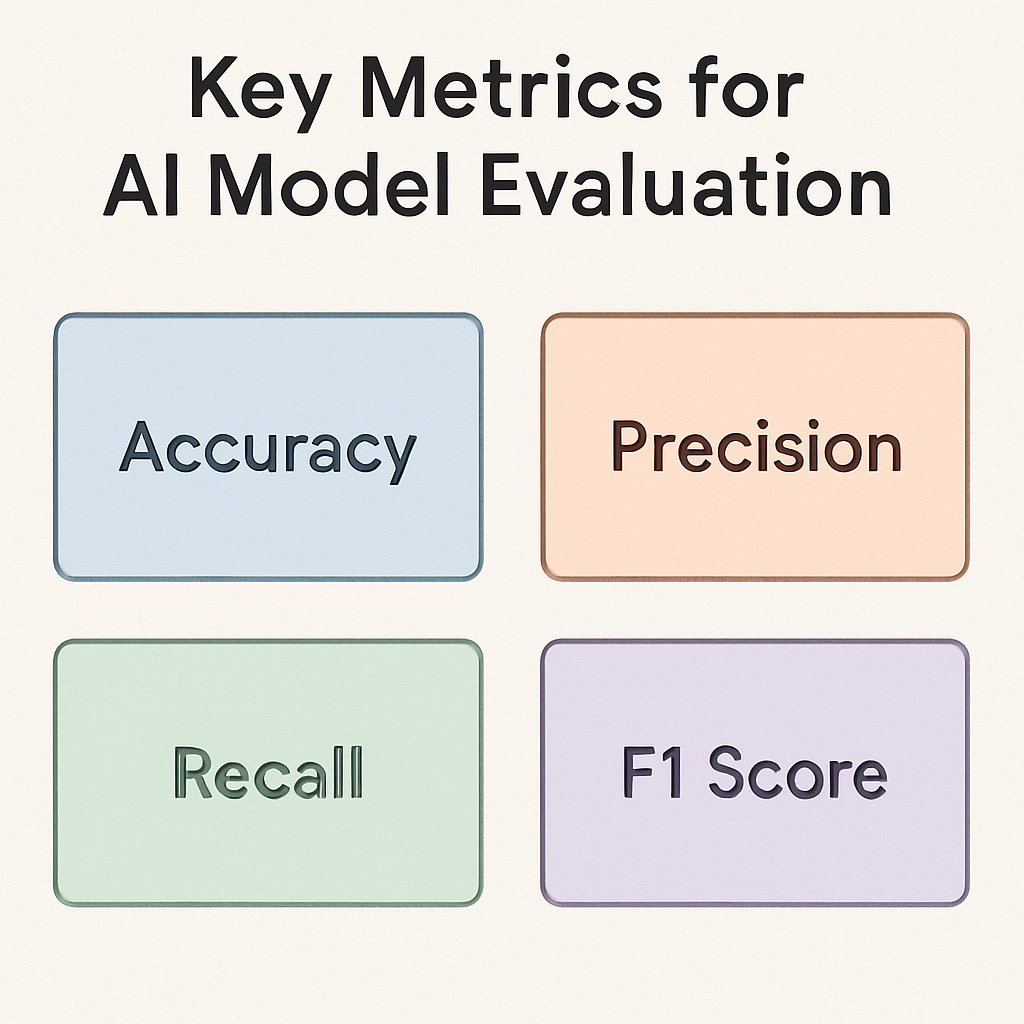
Now, let’s go over some key metrics used in evaluating AI models. These metrics shed light on different aspects of a model’s performance.
Accuracy

Accuracy is one of the simplest and most widely used metrics. It measures the model’s accuracy, i.e., the percentage of correct predictions. While accuracy is easy to grasp, it may not always be the best measure, especially with imbalanced datasets. In such cases, a model might seem adequate just by predicting the majority class most of the time.
Moreover, accuracy does not reveal the details of false positives and false negatives, which can be critical in specific applications. For example, in medical diagnostics, a false negative’s cost can outweigh the value of a high accuracy rate. Therefore, accuracy should often be combined with other metrics for a complete evaluation.
Precision

Precision shows us the proportion of accurate optimistic predictions among all positive predictions. It’s essential in scenarios where false positives are costly, such as spam detection or medical diagnosis. High precision means a low false positive rate, which is vital for applications where incorrect optimistic predictions can have serious consequences.
In domains such as fraud detection and security, precision can prevent unnecessary resource allocation to false alarms. However, precision alone does not account for false negatives, which is why it is often used in conjunction with recall to provide a more complete picture of a model’s effectiveness.
Recall (Sensitivity)

Recall, or sensitivity, measures the proportion of accurate optimistic predictions among all actual positive cases. It is essential because missing a positive case can lead to serious costs, such as in disease detection. High recall ensures that the model captures most actual positive cases, reducing false negatives.
In situations like emergency alerts or disaster predictions, recall is critical to ensuring that no significant events are overlooked. However, focusing too much on recall might increase false positives, which is why it is often balanced with precision using metrics like the F1 Score.
F1 Score
The F1 Score is the harmonic mean of precision and recall, balancing the two. It is beneficial for imbalanced datasets because it accounts for both false positives and false negatives. By balancing these two factors, the F1 Score provides a single metric for evaluating the trade-off between precision and recall.
In practice, the F1 Score can guide adjustments to model thresholds, helping to achieve the desired balance between precision and recall. It is invaluable in situations where both false positives and false negatives carry high costs, providing a more in-depth view of a model’s performance.
ROC-AUC
The Receiver Operating Characteristic (ROC) curve shows the actual positive rate against the false positive rate at different thresholds. The Area Under the Curve (AUC) quantifies the model’s overall ability to distinguish between positive and negative classes. A higher AUC indicates better model performance across different thresholds.
ROC-AUC is particularly valuable in binary classification problems. It provides insights into the trade-offs between sensitivity and specificity, allowing for comparisons of models regardless of threshold settings. This gives a broad view of classification capabilities.
Mean Absolute Error (MAE)
In regression models, Mean Absolute Error (MAE) measures the average size of errors across a set of predictions, ignoring their direction. It provides an easy-to-understand measure of prediction accuracy. MAE is intuitive, expressing errors in the same units as the data, making it easy to interpret.
MAE is robust against outliers, offering a straightforward assessment of model performance. However, it might not effectively capture the severity of larger errors compared to other measures, so it is often used alongside others like Mean Squared Error (MSE) for a more complete evaluation.
Mean Squared Error (MSE)
MSE is another measure for regression models. It calculates the average squared difference between predicted and actual values. MSE gives more weight to larger errors, which can be helpful when larger errors are particularly undesirable. By squaring the errors, MSE emphasizes deviations, providing a sensitive measure of prediction quality.
MSE is handy in situations where significant errors are harmful, such as financial forecasting or autonomous vehicle navigation. While MSE can be affected by outliers, it offers a clear indication of model reliability in high-stakes scenarios.
R-Squared
R-Squared, or the coefficient of determination, is a statistical measure that shows how well the model’s predictions match the actual data points. A higher R-squared value indicates better model performance. It provides a proportional measure of the variance the model explains, offering insights into its explanatory power.
R-Squared is intuitive and widely used in regression analysis, helping to understand the model’s fit. Still, it should be approached carefully, as it can be misleading in situations of overfitting or when comparing models with different numbers of predictors.
Performance Benchmarking
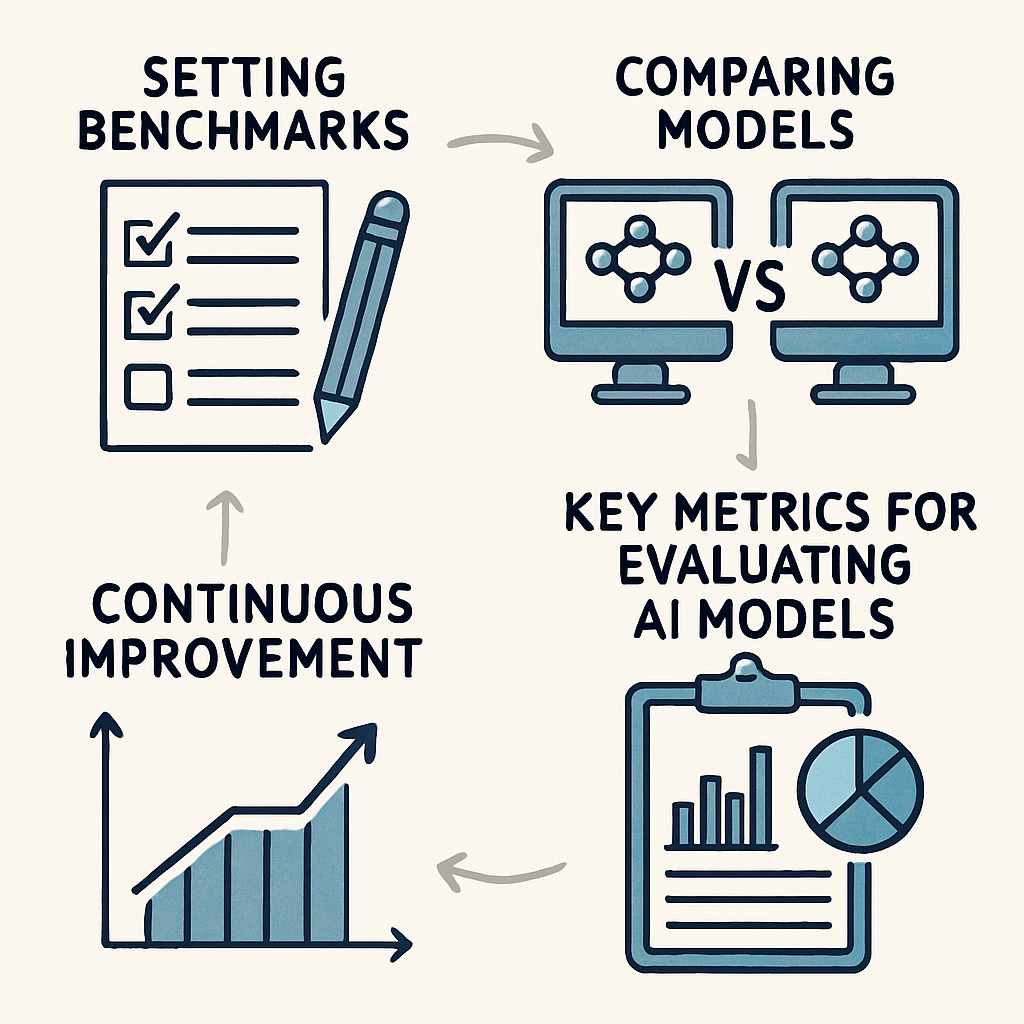
Performance benchmarking involves comparing your AI model’s performance against accepted standards or other models. This helps identify areas for improvement and ensures your model stays competitive.
Setting benchmarks means defining target performance levels for your model. These benchmarks could come from industry standards, previous models, or specific business needs. Establishing clear benchmarks ensures that model development aligns with strategic goals and offers a reference point for evaluation. Benchmarks can change as the industry evolves and new data appears. Regularly refreshing benchmarks keeps models competitive and ensures they meet changing standards and expectations.
Comparing Models
When comparing models, it’s important to use consistent datasets and evaluation metrics. This ensures a fair comparison and helps in selecting the best model for your needs. Consistency in evaluation allows for objective assessment, facilitating informed decision-making.
Comparative analysis can also highlight strengths and weaknesses across different models, guiding further development and optimization. This process is crucial in competitive industries where model performance directly impacts business success.
Continuous Improvement
Benchmarking is not a one-time activity but a continuous process that drives model improvement. By regularly comparing models against benchmarks and among themselves, organizations can identify gaps and areas for improvement. This iterative process fosters innovation and ensures models remain at the forefront of technological advancements.
Continuous improvement through benchmarking encourages a culture of excellence, pushing teams to refine and optimize their models consistently. This approach not only enhances model performance but also contributes to overall organizational growth and success.
Challenges in AI Model Evaluation
While evaluating AI models is essential, it’s not without challenges. Here are some common difficulties faced during the evaluation process:
Imbalanced Datasets
Imbalanced datasets, where one class significantly out numbers the others, can skew evaluation metrics such as accuracy. In such cases, precision, recall, and the F1 score are more reliable metrics. Handling imbalanced datasets requires careful consideration of sampling techniques, such as oversampling the minority class or undersampling the majority class.
Advanced methods such as Synthetic Minority Over-sampling Technique (SMOTE) can also be employed to generate synthetic examples, helping balance the dataset. Addressing imbalance is crucial to ensure models are trained effectively and provide reliable predictions.
Overfitting and Underfitting
Overfitting occurs when a model learns the training data too well, including noise and outliers, leading to poor generalization on new data. Underfitting happens when the model is too simple to capture the underlying patterns. Both issues can affect the evaluation process. Techniques like cross-validation, regularization, and early stopping can mitigate these issues.
Proper feature selection and data preprocessing also help prevent overfitting and underfitting. By carefully tuning model complexity, we can achieve a balance between bias and variance, ensuring robust model performance.
Selection of Appropriate Metrics
Selecting the right metrics for your specific problem is crucial. Different tasks require different metrics, and choosing the wrong ones can lead to misleading conclusions about the model’s performance. Understanding the domain and the specific objectives of the AI application is essential for selecting the most relevant metrics.
Consulting with domain experts and aligning metric selection with business goals can guide this process. A comprehensive evaluation often involves a combination of metrics to capture different aspects of model performance, providing a well-rounded assessment.
Conclusion
Evaluating AI models is a critical step in the development process, ensuring they perform effectively and meet the desired objectives. By understanding and using the right metrics, such as accuracy, precision, recall, and others, we can assess a model’s performance comprehensively. Performance benchmarking further enhances our understanding, allowing us to refine models and achieve better results.
With effective evaluation strategies, we can harness AI’s full potential, drive innovation, and enable informed decision-making across diverse fields. Through continuous evaluation and improvement, AI models can adapt to changing environments and continue to deliver value, pushing the boundaries of what is possible with technology.
Q&A
Question: Why isn’t accuracy alone a reliable metric for evaluating AI models?
Short answer: Accuracy can be misleading—especially with imbalanced datasets—because it doesn’t distinguish between false positives and false negatives. A model can appear “accurate” by predicting the majority class most of the time while missing critical minority cases. Complement accuracy with precision, recall, F1, and ROC-AUC (for classification) to capture error trade-offs and the model’s actual discriminative ability.
Question: When should I prioritize precision, recall, or the F1 score?
Short answer: Choose based on the cost of errors in your application. Use precision when false positives are costly (e.g., fraud alerts, medical positives that trigger interventions). Use recall when missing positives is expensive (e.g., disease detection, emergency alerts). Use F1 when you need a single score that balances both (e.g., when dealing with imbalanced datasets or when both error types matter).
Question: What does ROC-AUC measure, and how should I use it?
Short answer: ROC-AUC summarizes how well a binary classifier separates positive from negative classes across all decision thresholds. A higher AUC indicates better overall discrimination, regardless of the chosen threshold. It helps compare models fairly; then you can tune thresholds to achieve the desired precision/recall trade-off for deployment.
Question: For regression, when should I use MAE, MSE, or R-squared?
Short answer: Use MAE for an intuitive, unit-consistent view of typical error that’s less sensitive to outliers. Use MSE when significant errors are especially undesirable because it penalizes them more heavily. Use R-squared to understand how much variance in the target your model explains; interpret it cautiously, as it can look good even when a model overfits or variables are added without improving generalization.
Question: How do I run a fair evaluation and benchmarking process?
Short answer: Split data into training, validation, and test sets (or use cross-validation), and compare models on the same datasets with consistent metrics. Set clear performance targets tied to business goals, then iterate: tune hyperparameters, adjust features/algorithms, and reevaluate. Address common pitfalls by handling class imbalance (e.g., oversampling, under sampling, SMOTE), monitoring overfitting/underfitting (regularization, early stopping), and updating benchmarks over time as data and objectives evolve
Question: What is appropriate to measure when doing regression analysis — R-squared, Mean Absolute Error (MAE), or Mean Squared Error (MSE)?
Short Answer: The MAE is ideal if you want a simple, non-unit consistent sense of what the average absolute error is, and it does not have extreme outlier sensitivity. If you want to punish significant errors severely, the MSE is a better choice. The R-squared is useful for understanding how well your model explains the variability in your target variable. But be cautious when using it, since it can also suggest that your model is good at explaining variability simply because it has too many variables (overfitting) or because it adds variables that don’t improve overall generalization.
How would you conduct a fair benchmarking process to evaluate models?
Short Answer: Create a split for your data between a Training Set, Validation Set, and Test Set (or use Cross-Validation), and evaluate all models using the same data with the same metrics. Establish specific performance thresholds based on business outcomes, and through iterative steps of Hyperparameter tuning, modifying Features/Algorithms, and Re-evaluating performance, refine your model(s). Be aware of common pitfalls such as class imbalance (i.e., oversampling, undersampling, SMOTE), Overfitting/Underfitting (Regularization, Early Stopping), and update your Benchmarks periodically as Data evolves and Objectives change.