










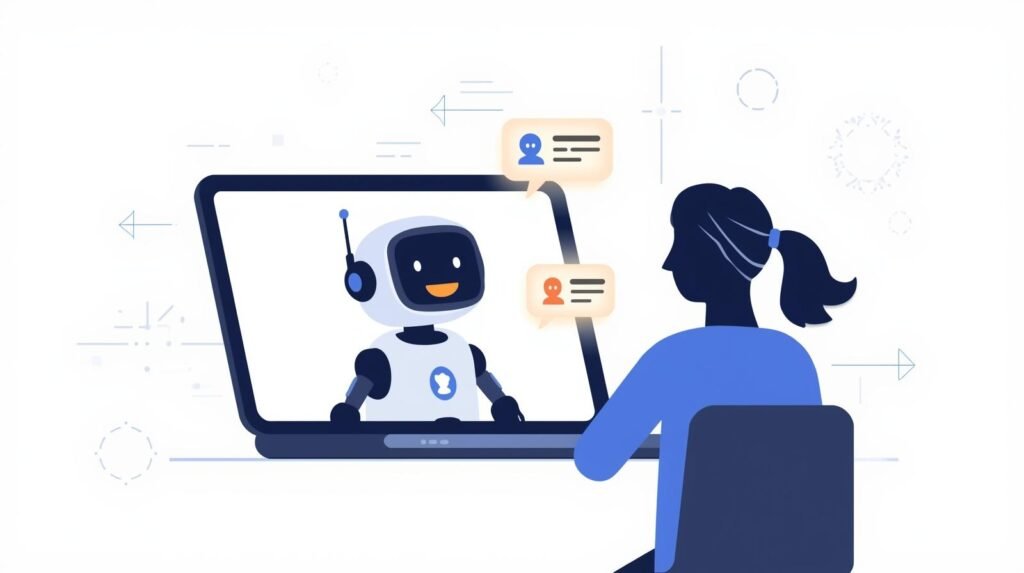
You likely have yelled at least once while using a customer service chat box, “Can I please speak with a real person?” You entered a simple question in the chat box and received a series of chatbot responses completely unrelated to your inquiry. This isn’t your fault; it’s how most companies create their chat boxes. They are designed much more like vending machines, where you put in a request and get a canned response, rather than being a helpful assistant.
On the flip side, if you asked a modern conversational AI (ChatGPT) to write a poem about your dog, it would be done in seconds! There is such a huge difference between these two AIs that it even makes you wonder what causes some to totally miss their goal, versus others who simply appear to grasp or “get” it.
#Understanding the Basics of Neural Networks: A Practical Guide
There are no differences between these two forms of Language Processing Systems; they are merely two fundamentally different approaches to training systems to process language. The first strictly follows the options provided by a predetermined menu of answers and therefore cannot “think” or provide responsive help beyond those options, which is why chatbots typically don’t work as well when you ask them something that isn’t on their menu. The second utilizes large databases of Human Language to train the System to both Interprete and Generate Flexible, Spontaneous Responses to the Question.
The Most Basic ‘bots’ — How They Are Limited To Understanding Certain Key Words
These easy-to-use “bots” are really just digital vending machines, not dialogue partners. Although they use words, they don’t intend to understand the meaning behind the words — rather, they try to link specific words with responses based on the programming that has gone into the machine. If you input an exact word programmed into its rules (“hours”, “password”), the bot will pull up the pre-programmed response associated with that word. However, if you ask the bot something more complex (“When are you open?”, “I’m experiencing difficulty accessing my account?”), The bot might not respond to your question at all since it was not programmed to recognize the words you used.
These chatbots can also seem very restrictive due to their rigid, rule-based architecture. The rigid nature of this architecture works well for simple, relatively predictable conversations (quick and efficient), but fails badly as soon as the conversation becomes slightly more flexible. So, how are more advanced chatbots able to determine that you are asking something else besides exactly what you type?
Rule-Based vs AI Chatbots Comparison
| Feature | Rule-Based Chatbots | AI-Powered Chatbots |
|---|---|---|
| Understanding | Keyword-based | Context+intent |
| Flexibility | Limited | High |
| Learning Ability | None | Continuous learning |
| Use Case | FAQs | Customer support, assistants |
| Accuracy | Low | High |
Source:
What is Your Intent? The Secret to How Modern Chatbots Understand Your Goal
You’ll need to think about your “intent”, which is how advanced chatbots will determine your end-goal. Unlike old systems, which relied on strict keyword searches to identify your goal, intelligent chatbots learn your end goals by training on your entire conversation. Like a well-trained employee at a store, if you walk into a store and ask for help (e.g., “Can you tell me where the milk is?” or “I am looking for the milk”), he/she would quickly realize that your intent was to locate a product. Similar to the employee who assists you at a store, modern chatbots will be trained to assist you, rather than programmed with rigid rules. Intelligent chatbots want to know your intent, rather than focus solely on your exact wording.
As such, there isn’t really “magic” behind this — it is simply the result of intentionally training the chatbots. As part of their development, the developers train the artificial intelligence in their chatbots using hundreds or thousands of examples of different wording that ultimately lead to the same final objective. For example, the developers would teach the AI that each one of the following requests represents the same ultimate goal — tracking an order: “Where is my package?”, “Track My Order” and “When can I expect delivery for my products?” Once the AI recognizes this pattern among all of those examples, it can understand where you’re trying to send your request, no matter what specific words you use.
Because intelligent chatbots are focused on helping you achieve your objectives, you don’t have to worry about figuring out the “right magic words” so that they can help you. Therefore, you can communicate more easily without having to deal with some of the frustrating loops that usually come with communicating with less sophisticated bots.
#Understanding Sentiment Analysis: A Comprehensive Guide
Intent Recognition Example
| Example | User Query Interpretation |
|---|---|
| User says: | I need a flight tomorrow |
| Chatbot understands | Intent-Book travel |
| Entities-Flight, date=tomorrow | |
| Result | Accurate response generation |
| Faster task completion |
Source:
Identifying What Matters: How Chatbots Identify Relevant Information
Once you’ve identified your goal (your intention) with a chatbot, the next step is to fill in the blanks. While being able to say you want to “book a flight” is a great way to start, there’s much more to do before taking action. The chatbot needs all of those extra details (the specifics): Where are you flying to? What date or time would you like to fly out? How many people are planning on making this trip? All of these are essential details for distinguishing how well you know what you want versus actually accomplishing something. They represent the primary components (the necessary ingredients) for the chatbot to gather before performing as intended based upon the recipe developed by your intent.
A type of artificial intelligence is trained for a specific purpose: named entity recognition. As its name suggests, this is a very complex method for identifying different data segments. However, when applied to chatbots, each data segment is referred to as an “entity.”
- For instance, when the user states, “Book a flight to Paris for two people tomorrow,”
- The chatbot will identify the location, “Paris,” as a “Location.”
- the number, “two people” as a “Number”,
- the date, “tomorrow”, as a “Date”.
The training of the chatbot with all possible methods of classifying data enables it to extract the correct data from your natural language sentence or query, no matter how you phrase it.
The integration of identifying what you intend to do and then retrieving the entities required to accomplish it is the primary method by which most modern chatbots determine what to do based on what you say and send back actions (such as searching for flights). The chatbot uses a two-step method when determining what to do with your input. First, the chatbot determines your general intent. Secondly, the chatbot extracts all the necessary data related to the entities required to achieve that goal. After the chatbot determines both your intent and the required entities, it will take some action (such as searching for flights). How does the “thinking” part of the chatbot enable it to identify both intent and entities?
The Chatbot’s Brain: How NLP, NLU, and NLG Work Together
The core of this chatbot is based on 3 key technologies – NLP, NLU & NLG.
NLP is one of many areas of artificial intelligence. It allows the computer to understand human language — read the content you enter/submit (in other words, what you typed/write), and produce a meaningful reply. This represents the fundamental basis for transforming an otherwise simple computer program into a conversational companion.
To effectively interact with users via a chat session, there are 2 major functions that a chatbot needs to perform: comprehend the content of the user’s message(s); then create a useful response. There is no way to perform these two actions in isolation from each other. In fact, they represent a series of steps. Step #1: Process the jumbled mess that humans call language (i.e., take your human-written/input), break down the various forms of human communication (words) into something that can be understood by the machine (data). Then step #2: Understand the underlying intent or purpose of the human input (i.e., think about your input); identify the true intended meaning of your input (i.e., grasp); and finally, build a new human-sounding sentence in order to respond (i.e., develop).
There are clearly 3 different but connected elements of an entity that can easily be thought of as individual parts of an “entirety”. Those elements are:
1. Natural Language Processing (NLP): The Ears: This first part begins the process of analyzing and processing your raw language. NLP takes your raw language and transforms it into a data-based format that computers can utilize. This is essentially how the computer can properly process your input.
2. Natural Language Understanding (NLU): The Brain: When it comes to this element, it is where the input you provided is processed and analyzed. NLU analyzes and interprets your input so that it can determine what exactly you were trying to say or do. Ultimately, NLU identifies the specific intent behind your input and extracts all the important information.
3. Natural Language Generation (NLG): The Mouth: After NLU has determined what you were trying to communicate through your input, NLG produces a natural language output (human-sounding sentences) in response.
In combination, NLP-NLU-NLG (Natural Language Processing-Natural Language Understanding-Natural Language Generation) provides the ability for a chatbot to listen/respond/think/speak. Many customer service chatbots currently used today rely on this type of natural language architecture. A recent model has created a new platform for this type of technology.
#A Comprehensive Guide to AI Model Types
NLP, NLU, NLG Breakdown
| Component | Function | Example |
|---|---|---|
| NLP | Processes language | Tokenization |
| NLU | Understands intent | Book a flight - travel intent |
| NLG | Generates responses | Chat reply generation |
Source:
The Artificial Intelligence Revolution: How “super powered autocomplete” has changed everything
A lot of NLU’s intent-identification functionality works really well for structured activities (e.g., booking a flight). However, today’s advanced AI chatbots (including ChatGPT) use a different paradigm of thought and function differently. Instead of requiring developers to write rules for each specific goal users might have, developers train their chatbots to learn language by reading billions of web pages, books, and articles.
The main idea behind this design method is quite different from the auto-complete features in your phone. Nonetheless, the technology used to achieve this design is nearly identical to the auto-complete feature on your phone. Just like how your phone’s auto-complete provides possibilities for the next word as you type, based on the most common combinations of words that people normally type, this method uses exactly the same process, but instead of using data from normal users, it uses data from hundreds of billions of web pages, books, and articles. This creates a model, referred to as a Large Language Model (LLM), that becomes extremely proficient at determining the most likely next word, regardless of context.
This ability allows them to create text one word at a time and gives them an element of creativity. Rather than responding with an existing piece of writing or an established intent based on the user’s input, the LLM creates a new response by stringing together statistically probable words. The ability to generate is a significant technical advancement; however, it relies on patterns. Therefore, it explains why some of their responses will appear very fluid, while others will appear strange or nonsensical.
Chatbot Usage & Impact Statistics
| Metric | Data |
|---|---|
| Businesses using chatbots | 80% + by 2025 |
| Customer queries handled by bots | 70% |
| Cost savings with chatbots | up to 30% |
| User satisfaction increase | Significant |
| AI chatbot market growth | Rapid (billions USD) |
Source:
The Human Aspects of Artificial Intelligence That Advanced Chatbots Just Don’t Understand
Chatbots generate text very well, but they have trouble with non-robotic ways. Do you remember the last time you followed up on a previous question (i.e., “what if it’s less expensive?”) and found that the chatbot had no idea what “what” you were referring to? This illustrates how difficult it is for Artificial Intelligence systems to understand contextual references. One of the biggest obstacles for Artificial Intelligence is keeping track of a sequence of messages in a conversation. Most AI systems process each incoming message as an independent event from other events in the conversation.
The issue can be addressed by using a “Dialogue Management” technique used for chatbots to act as their memory (short term) to attempt to remember all of the main items you’ve previously told them about (like the product you’re looking at or the city you are traveling to). When Dialogue Management works successfully, conversations seem natural. However, when Dialogue Management does not work successfully, conversations seem unnatural because you will have to repeat yourself when the chatbot forgets the last conversation item. The limitations demonstrate the distinction between pattern identification and actual comprehension.
Another major gap for artificial intelligence (A.I.) is in the realm of human subtlety (nuance). To illustrate the issue, if someone says, “Oh fantastic, my flight has been delayed,” most humans would realize the sarcastic tone behind the wording; a.A.I. system, however, since it was only able to connect “fantastic” to feelings of joy, would completely fail to catch the irony, thinking instead that you were pleased that your flight had been delayed. That is due to the fact that artificial intelligence systems look strictly at the literal words and ignore the emotional context, the history of your previous conversations, as well as the connection that allows for sarcasm to convey the intended message of the writer.
Therefore, we have customer support chatbots responding to customer complaints by saying things like, “That’s great! Is there anything else I can help you with?”
The crux of this conflict lies within the concept of Sentiment Analysis — which is essentially how artificial intelligence (a.i.) attempts to interpret the emotional significance of what you write. Although, sentiment analysis has made significant advancements in recognizing overtly expressed emotions such as happiness and anger, it is easily mislead when analyzing complex or sarcastic expressions of emotion that individuals use throughout their everyday writing. In other words, while the A.I. doesn’t truly experience your frustration (as opposed to making an educated guess based upon the way you have written), it is merely attempting to make an educated decision regarding whether you are expressing frustration. Therefore, until a.i. can comprehend the complexities of human communication, chatbots will continue to be very successful in communicating with customers but they will also be very patient; requiring additional tools to enable clear and effective communication.
#Essential Key Metrics for Effectively Evaluating AI Models
Human vs AI Language Understanding Limitations
| Aspect | Humans | Chatbots |
|---|---|---|
| Emotion Understanding | High | Limited |
| Context Awareness | Strong | Improving |
| Ambiguity Handling | Natural | Challenging |
| Creativity | High | Limited |
| Learning | Flexible | Data-dependent |
Source:
How It Impacts Your World: How to Communicate Effectively with Smarter AI
Understanding how modern AI systems are developed and function will help you see the differences in the level of intelligence between today’s AI and yesterday’s (both of which produced answers just as obscure as unclear). Once you have this knowledge, you can be a participant in conversations with AI instead of simply receiving output from it.
The opportunity to develop your conversation flow with your chatbots is based on what we’ve covered today. Use this learning in your next interaction with an Artificial Intelligence by applying these three simple steps:
- As clear and specific as possible: in place of stating “I’m having an issue,” state it as “my password is not resetting for my account located at user@email.com.
- Alternative ways of stating the question: if the AI did not pick up on what you are asking, try again with your question using different language. At this point, you also understand how the AI identifies both intent and entity.
- Contextual information: when completing more complex requests, provide all of your request information in a single step (e.g., I want to reserve a hotel in Chicago for two adult travelers from June 10th through June 12th.)
This has evolved beyond just a mechanical machine and is currently a directional tool. The limitations on how you could communicate with your computer previously existed based solely on the use of spoken words. Today, you can be said to “be participating in the meeting”, as you are able to help reach an agreement or understanding among individuals, and also create an impression that interaction with computers will seem like it is being done through interaction with humans.
Effective Chatbot Communication Tips
| Tip | Why It Works |
|---|---|
| Use simple language | Easier for NLP |
| Be specific | Better intent detection |
| Avoid ambiguity | Reduces errors |
| Provde context | Improves responses |
Conclusion
As chatbots’ ability to understand human language continues to evolve, opportunities are emerging for businesses and individuals to leverage them for search, education, and assistance. Each successful interaction with a chatbot is made possible by a variety of NLU capabilities, including but not limited to tokenizing and embedding user input into a vector space, classifying intent from user input, and using generative models that mimic natural language. Although current advancements in artificial intelligence (AI) language processing have improved our ability to communicate with machines in ways similar to how we communicate with other humans, we still have far to go in closing the gap between machine-based and human-based communication. Companies that have continually built out and trained their conversational AI systems will create the most innovative and valuable conversational AI solutions, generating the highest level of customer value in each conversation.
Q&A
Question: In what way do chatbots actually “understand” natural spoken language?Answer: By converting text into some sort of numerical representation (embedding), chatbots use a combination of various machine learning model types (e.g., especially, large language models (LLM)) that are trained with enormous volumes of written text data to identify possible patterns in, possible meanings of, and possible next word(s) and/or response(s). In other words, this is simply statistical pattern matching (and not “comprehension” as humans experience it), yet statistically-based pattern matching can mimic comprehension in many instances.
Question: How is Natural Language Processing (NLP) used by chatbots?Answer: The purpose of using NLP for a chatbot is to take a user’s input and break it down into its various components, including tokens (words), parts of speech (nouns, verbs etc.), entities (the people, places, organizations, etc., that are mentioned), intent (what the user wants), and sentiment (how the user feels). After breaking down the user’s input in this way, the chatbot will use the structured representation to select an answer from a database or generate a response based on the input.
Question: How do chatbots deal with ambiguity, slang, or typos?Answer: Modern Models are trained to learn and be able to make inferences about what a user means based upon the users’ context (even if the user made spelling mistakes or uses slang), based upon training data that includes all kinds of “noisy” (e.g., incomplete or grammatically incorrect) data from real users; and thus will find the most likely interpretation by comparing the user’s input to the hundreds of thousands of examples they have learned from in their database.
Question: How do the language understanding abilities of AI-powered chatbots differ from those of rule-based chatbots?Answer: Chatbots that are based on the “if–then” rule model will use static keywords to find a match (or lack thereof) for each user question/input, and these types of chatbots will quickly fall short when users ask the same question but with a different phrase. Chatbots that use machine learning and/or deep learning can learn to respond to many variations of the same question, allowing users to communicate in an open-ended/conversational way.
Question: Are today’s AI-based chatbots able to understand language as we do?Answer: No—not yet. Today’s chatbots lack the ability to be conscious, possess intentionality, or have a “grounded” experience (i.e., a direct experiential connection to the world around them). Instead, they work by statistically modeling the relationships within language. While today’s chatbots can reason with us and converse in ways that resemble human conversation, this “understanding” of ours is fundamentally different from what we call “cognitive understanding.”